TAOM™ Architecture
Architecture is the bridge between intent and execution.
Strategy defines where the organization is going. Processes define how work gets done. Technology enables execution. AI introduces a new form of work. Architecture makes the relationships between them visible – and therefore manageable.
Beyond IT Architecture
Eight questions architecture needs to answer
Traditional Enterprise Architecture focuses primarily on applications and technology. For an AI-native organization, that is no longer enough.
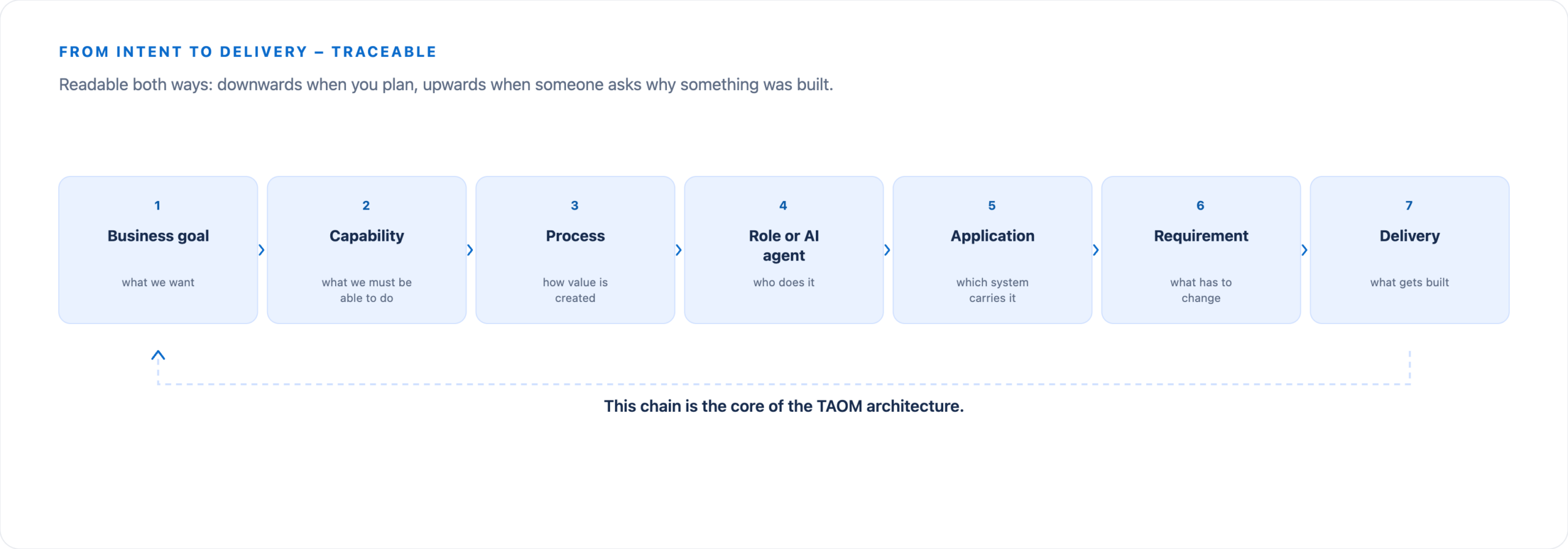
The core chain
From intent to execution – fully traceable
This chain is at the core of TAOM Architecture. It can be read in both directions: top-down when planning, and bottom-up when someone needs to understand why something was built.
Human and AI
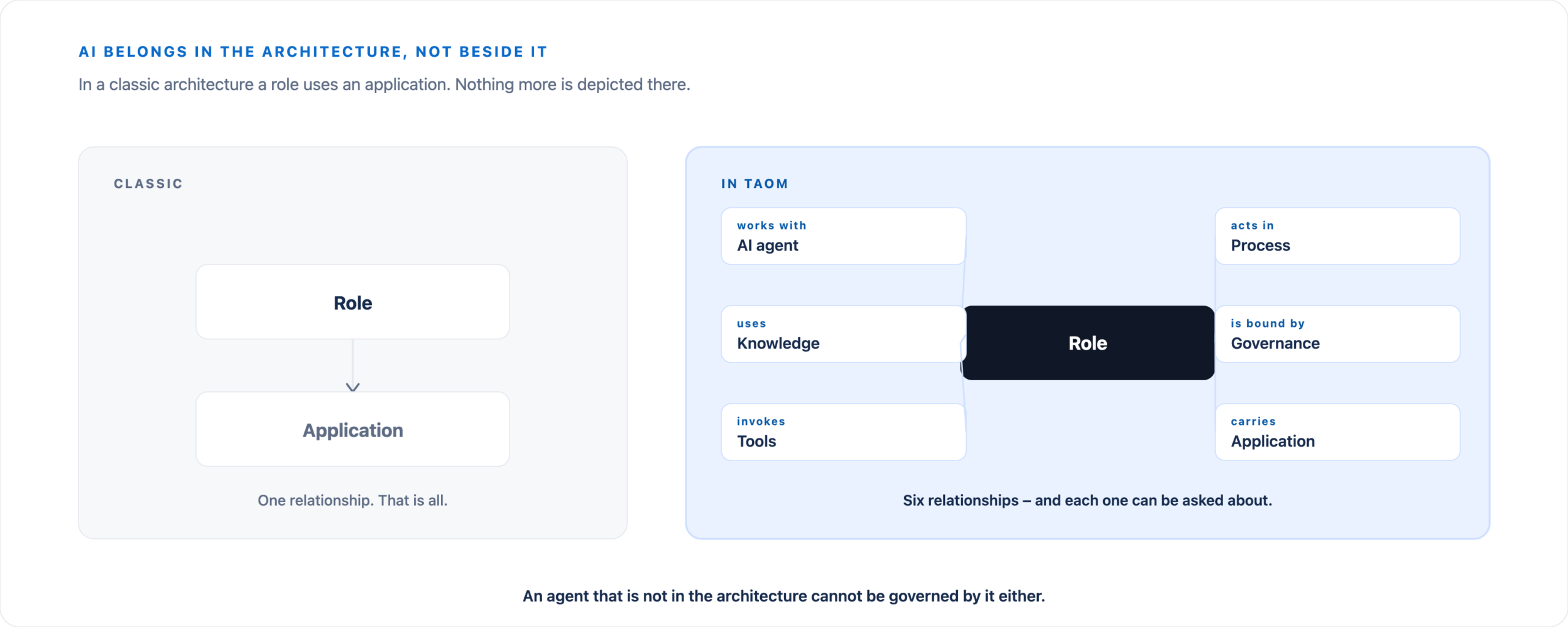
AI belongs inside the architecture, not alongside it
In traditional architecture, a role uses an application. That is usually where the representation ends.
Context Architecture
What AI needs in order to act meaningfully
An agent without context is forced to guess. Architecture provides six types of context – only together do they create a reliable foundation.
The eight domains
Views that belong together
Scope
Not a replacement for your Enterprise Architecture tool
What remains in place
TAOM does not replace specialized Enterprise Architecture repositories. They remain the authoritative systems for their respective domains – including application landscapes, capabilities, and technology portfolios.
Existing investments should not be discarded.
What TAOM adds
The shared organizational context connecting architecture, processes, requirements, AI, and transformation – precisely the relationships that otherwise fall between individual tools and domains.
Architecture provides the structure; the Digital Twin makes it navigable.
Moving into execution
Architecture asks what. Engineering asks how.
Architecture answers: What needs to exist, and how does it fit together? Engineering answers: How do we build and evolve it? This separation of responsibilities is built into TAOM.
- Target Architecture
- Capabilities
- Processes
- Systems
- AI
- Requirements
↓ handover to Engineering
- Design
- Build
- Integrate
- Validate
- Deploy
- Improve
Not set in stone
A Target Architecture designed to evolve
Markets, processes, applications, AI capabilities, and regulations change – usually at different speeds and rarely with advance notice. An architecture that cannot accommodate change eventually becomes a collection of outdated diagrams.
- Understand
- Design
- Build
- Observe
- Learn
- Adapt
That is why Architecture in TAOM is part of the same continuous cycle as everything else – not a document that gets updated once a year.
 Continue exploring
Structure only becomes useful when you can navigate it
Architecture defines what belongs together. It becomes visible and usable in the model – where Capability, Process, Application, and Requirement are actually connected.