Resources
Understand, try, apply.
Not a place to store files but a place to learn: interactive process examples, guides, use cases, articles and terms – alle miteinander verknüpft.
Five areas
Five ways in – depending on what you have in mind
Whether you want to see a process, learn the tool, understand an industry or simply look up a term.
01
BPMN-Demos
Look at processes instead of reading about them. Interactive models created and enriched in Process Studio.
View demos →
02
Documentation
Describe, generate, model, enrich, review, publish – explained step by step.
Read the documentation →
03
Use Cases
How method, Process Studio, agents and Digital Twin work together in real projects – by industry.
View use cases →
04
Insights
Thoughts on the AI-native organisation: processes, structures, architecture, governance – no product announcements.
Read Insights →
05
Glossary
The language of the AI-native enterprise: clear definitions and how the terms connect.
Open the glossary →And in between
The links
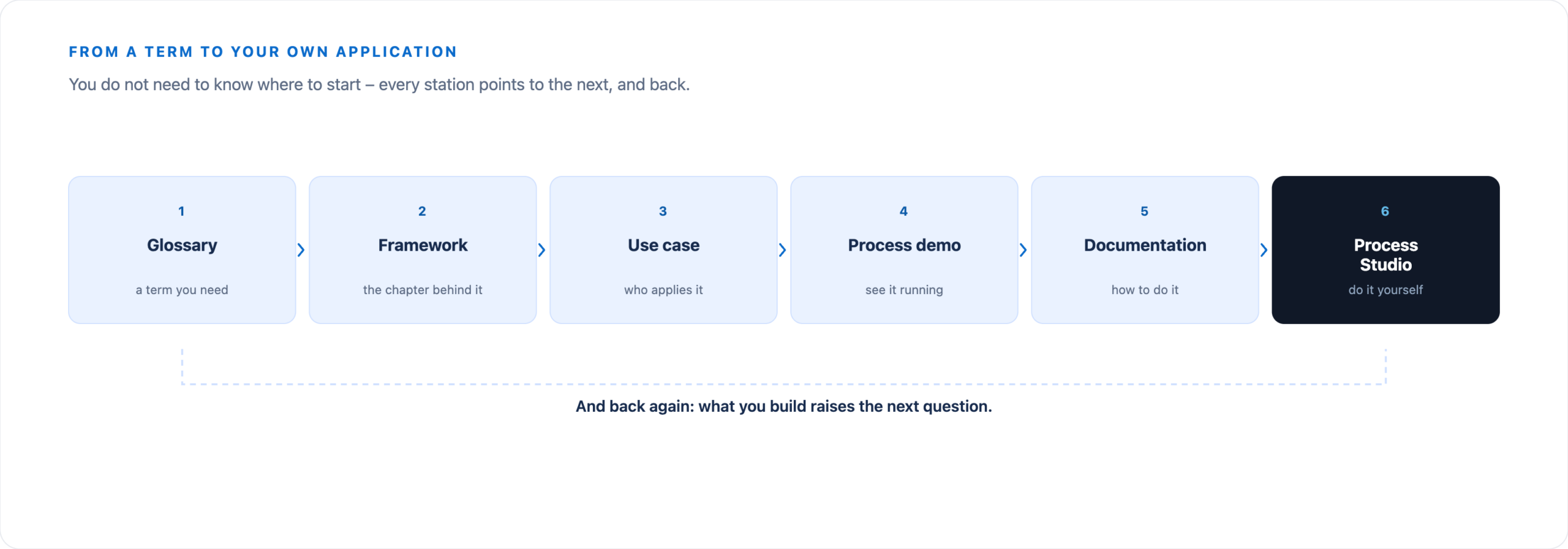
A term leads to the framework chapter, the chapter to the use case, the use case to the demo, the demo to the guide. That is what turns five areas into a network of knowledge.
The common thread
From the term to your own application
You do not need to know where to start. Each station points to the next – and back.
01 · BPMN-Demos
Look at processes instead of reading about them
The demos show how a description in everyday language becomes a structured process model – and how further enterprise context can be attached to individual steps.
- BPMN 2.0 activities
- Events and decisions
- Roles and accountabilities
- Systems and applications
- Process descriptions
- Requirements
- Controls
- Documentation
- AI-generated entries
Worth knowing
The demos run in the TAOM BPMN Viewer straight in the browser – no download, no installation. If you want to model yourself, open the same examples in Process Studio.
02 · Dokumentation
How to work with TAOM
The documentation walks through Process Studio and the capabilities around it – from the first description to the published version.
- First stepsUnderstand the canvas and create your first process.
- Generate processes with AIHave a model built from a description in everyday language.
- Model in BPMNCreate and change models to BPMN 2.0.
- EnrichConnect steps with roles, systems, requirements and business text.
- CollaborationReview and develop models together.
- GovernanceReview, human approval, provenance and versioning.
- Import and exportBPMN, HTML, PDF and the supported connections.
Related
Solutions shows what you use the tool for.
The method explains why it is built this way.
03 · Use Cases
How others apply it
Each use case shows not only the process but the context around it: roles, systems, requirements and controls.
- SAP S/4HANA transformationBest practices and fit-to-standard become customer processes, requirements, WRICEF objects and delivery artefacts.
- Pharmaceutical manufacturingRegulated production with quality controls, batch tracking, documentation and compliance obligations.
- Industrial manufacturingCustomer order, engineering, procurement, production, quality and service in one context.
- Food productionTraceability, batches, shelf life, production, quality and warehouse connection.
- Public administrationProcedures as traceable digital workflows with forms, approvals, interfaces and decisions.
Being built
The detail pages per industry are appearing one by one. First examples are already available as a BPMN-Demo bereit.
04 · Insights
The idea behind the adaptive organisation
Technology alone does not make an adaptive organisation. This is about how AI changes processes, structures, architecture, governance and transformation – not about product announcements.
- AI-native organisations
- Adaptive organisations
- AI and BPMN
- Process Intelligence
- Enterprise Digital Twin
- AI agents
- Human–AI collaboration
- Process governance
- Requirements management
- Enterprise architecture
- SAP transformation
- AI governance
On naming
In the menu this area is called Insights. The address stays /blog/ – so existing links and search rankings are not lost.
05 · Glossar
The language of the AI-native enterprise
AI, process management and transformation bring many terms that everyone understands slightly differently. The glossary explains them – and shows how they connect.
- Adaptive organisationAn organisation that continuously learns and adjusts structures, processes and capabilities.
- AI-native organisationAI is part of the operating model, not a tool beside it.
- AI agentA governed digital role that performs defined tasks with knowledge, tools and permissions.
- Process Digital TwinA living picture of a business process together with its organisational surroundings.
- Enterprise Digital TwinProcesses, capabilities, roles, systems, requirements, knowledge, controls and AI agents in context.
- Human in the loopPeople keep the defined responsibility for reviewing, approving and governing AI-generated results.
- Process discoveryThe systematic capture and ordering of what is actually done.
- WRICEFClassification of development objects: workflow, report, interface, conversion, enhancement, form.
Being built
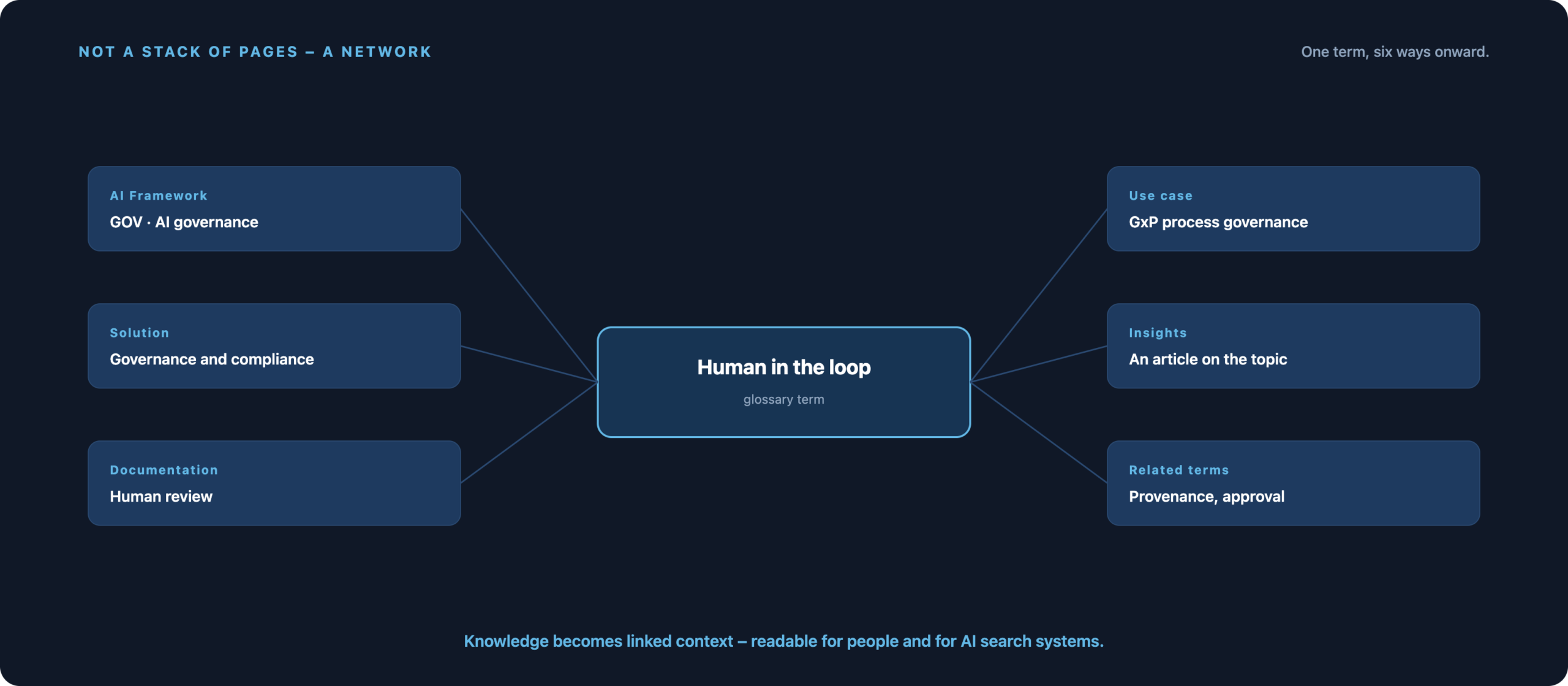
Each entry gets its own page with links to framework chapter, solution, documentation, use case and article.
Linked knowledge
Not a stack of pages but a network
A glossary term leads to the framework chapter, the chapter to the use case, the use case to the demo, the demo to the guide. The same principle TAOM works by internally: knowledge becomes linked context.
Choose your entry point
Where would you like to start?
Start with one process
Look at an example, read how it came about – and build the next one yourself.