TAOM™ Certification
Trust is built through verifiability, not claims.
Who created it? Which method was used? Was AI involved? Has a human reviewed it? Which version is authoritative? And what qualifications does the person who created it have? You should be able to answer these questions without having to take anyone’s word for it.
- Learn
- Apply
- Validate
- Verify
Keep the distinctions clear
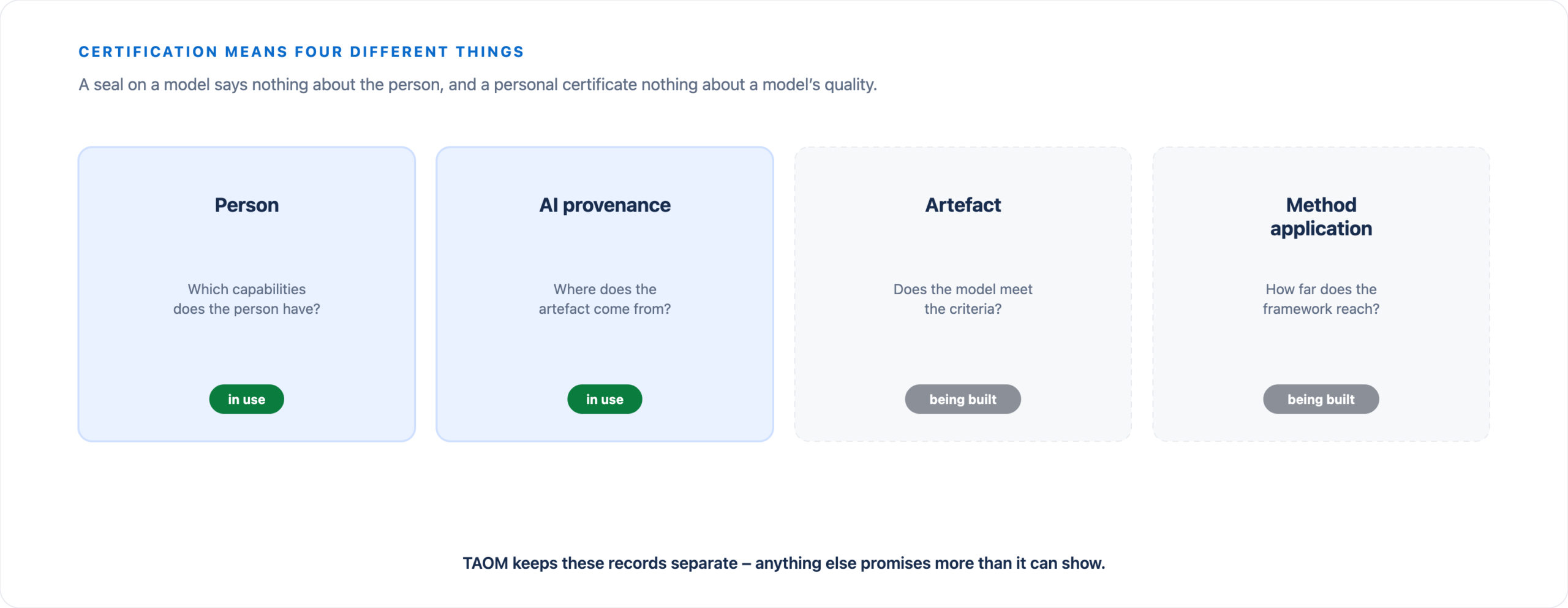
Certification means four different things
A seal on a model says nothing about the person who created it, and a personal certification says nothing about the quality of a model. That is why TAOM keeps these credentials separate.
People
Three levels, each certified separately
Personal certification builds on TAOM training. Each level can be certified independently; anyone who completes all three meets the professional qualification requirements to operate their own TAOM environment.
Modeller
Editor and process methodology: model, import, and reuse BPMN.
Agents
Understand and apply agents – models, standards, and elaboration.
Infrastructure
Architecture, tenant separation, integration, and operations.
Artifacts
The quality seal on the model
A model created or modified in TAOM can carry information about its provenance and quality status. The meaning of each status must remain transparent and verifiable – otherwise, a seal is nothing more than a label.
Assessment criteria
How a model can be assessed
A process model is more than valid BPMN syntax. Whether the necessary business context is included can be assessed against eight criteria.
Structure
Is the model technically valid?
Business Content
Are the process steps described in sufficient detail?
Roles
Is it clear who is responsible?
Systems
Is the relevant application context available?
Requirements
Are the relevant requirements linked?
Governance
Are the required controls represented?
Provenance
Is the origin of the artifact known?
Human Review
Has generated content been reviewed by a human?
Method Application
Many organizations use individual TAOM building blocks without implementing the entire Framework. Method Certification is intended to make transparent how extensively the method is being applied.
Terminology matters
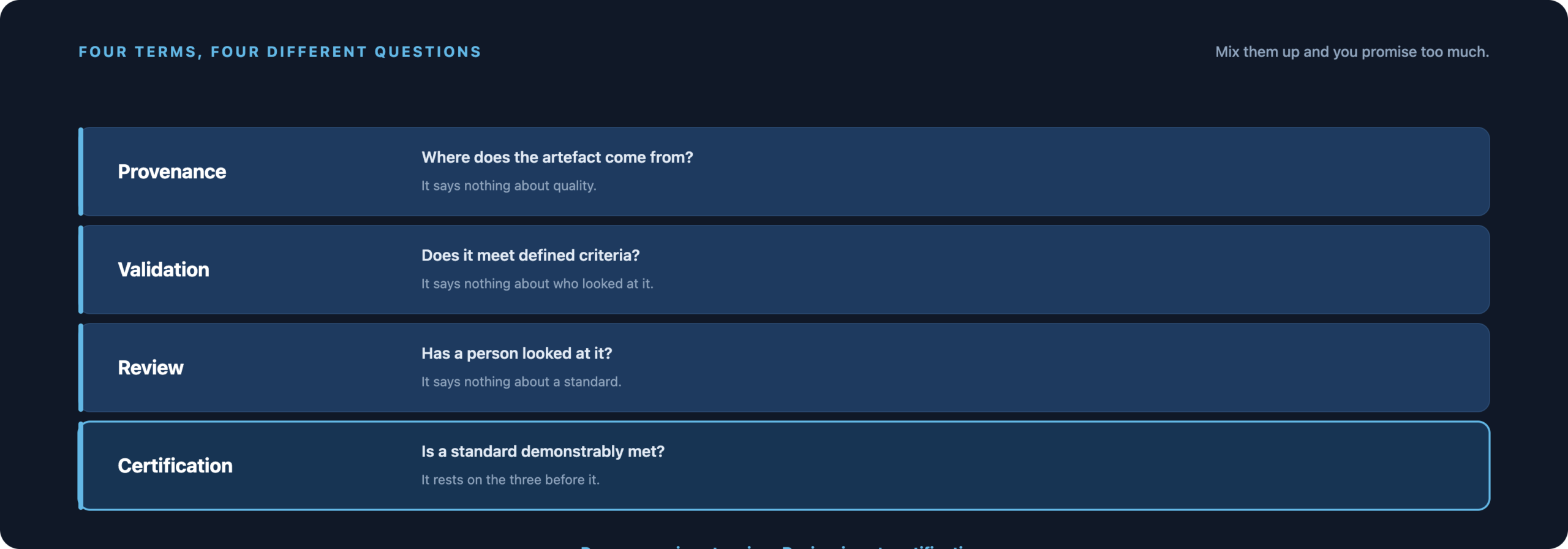
Provenance, validation, review, certification
These four terms are often used interchangeably. But they answer different questions – and confusing them means claiming more than can actually be demonstrated.
The path
From learning to verifiable certification
- Learn
- Explore
- Apply
- Demonstrate
- Assess
- Certify
- Keep current
The final step is often forgotten: a method evolves, so its certification must evolve with it. A certificate without a validity period is not a meaningful certificate.
Learn
Foundations in the AI Framework, examples and guidance in Resources.
Apply
Real work in Process Studio, real transformation initiatives in Solutions.
Verify
Provenance and governance under Compliance & Governance, certificates via the Verification Page.
Our standard
A badge alone is worthless
Certification only has value if seven questions can be answered. These are the criteria we expect to be measured against.
- What exactly was certified?
- Against which criteria?
- By whom?
- When?
- Against which version of the standard?
- Is the certification still valid?
- Can it be independently verified?
Getting started
Build capability first. Certify it second.
Learn the method, apply it in real work, disclose the involvement of AI, have the results reviewed – and make the evidence independently verifiable. In that order.