Mechanisms do not run themselves. Someone has to lead them.
In TAOM, Management is not a layer above the organization. It is the continuous operation of its mechanisms: setting direction, making decisions, measuring impact, and leading adaptation – now with AI workers as part of the workforce.
What changes
Four questions leaders never had to ask before
New on the leadership agenda
Who is accountable for an outcome generated by an Agent? Which decisions may be automated – and which must never be? How do you plan capacity when part of the work is performed by software? And how do you measure performance when speed is no longer the constraint?
These questions span several management disciplines. That is why AI does not sit in a separate chapter on the sidelines – it is embedded directly in Workforce Management under MGT-08.
What remains the same
Strategy, Organization, Capabilities, Knowledge, Decisions, Processes, Resources, Governance, Performance, Change, and Delivery have always required management.
TAOM does not invent a new management doctrine for them – it structures established management disciplines so that AI fits into them coherently.
Overview
Twelve areas that need to be managed
Each discipline manages part of the Operating Model. When one fails, the effects usually become visible somewhere else first.
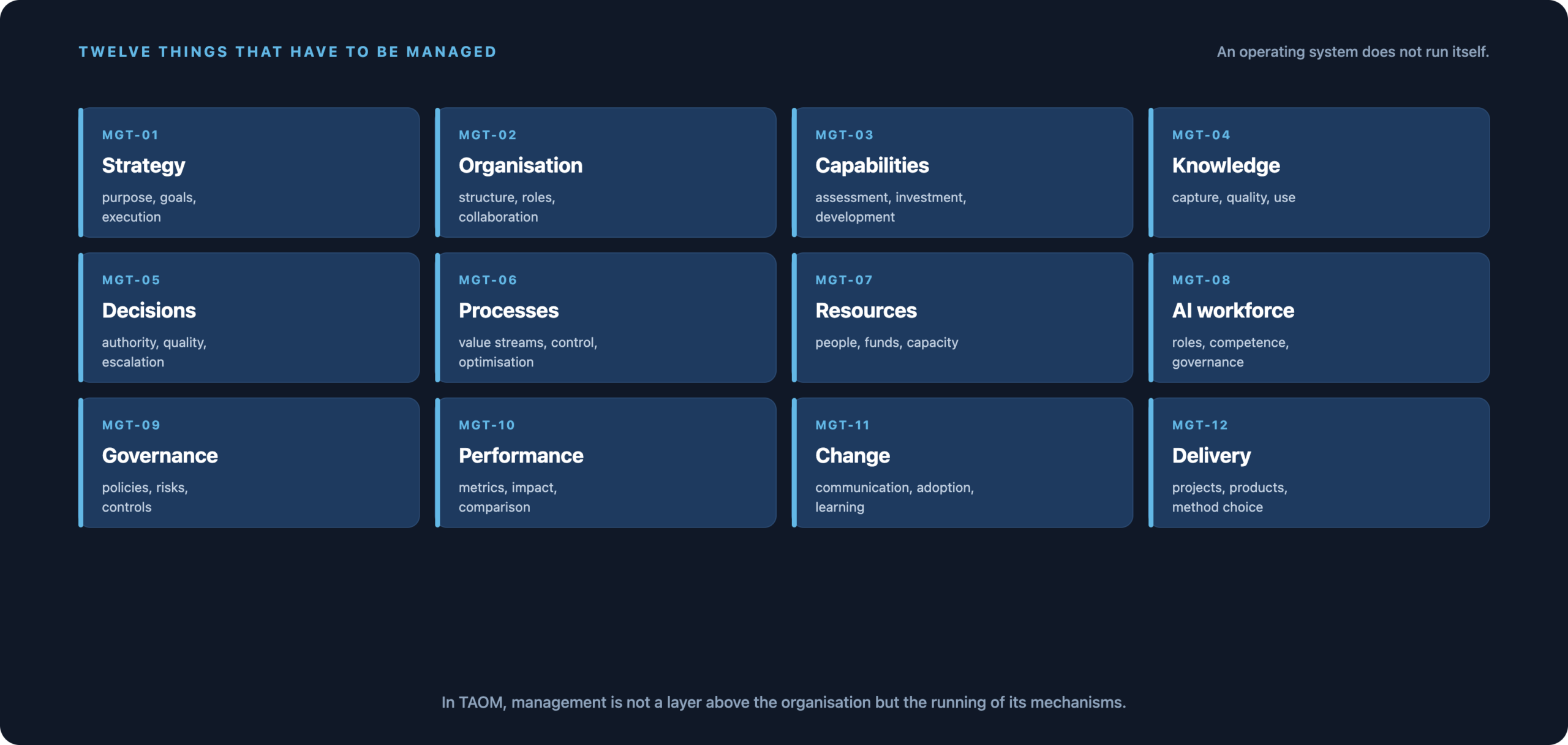
Chapter Overview
What each chapter covers
- MGT-01Strategy ManagementPurpose, Vision, Mission, Strategic Objectives, Priorities, Execution, and Governance.
- MGT-02Organization ManagementStructure, Roles, Responsibilities, Collaboration, Development, and Organizational Health.
- MGT-03Capability ManagementIdentification, Assessment, Ownership, Investment, Roadmaps, and Development.
- MGT-04Knowledge ManagementCapture, Structuring, Quality, Governance, Distribution, and Use.
- MGT-05Decision ManagementDecision Paths, Authority, Quality, Bias, and Escalation.
- MGT-06Process ManagementValue Streams, Processes, Workflows, Governance, Process Mining, Automation, and Optimization.
- MGT-07Resource ManagementHuman, Financial, Physical, Digital, and AI-related Resources, including Capacity Management.
- MGT-08AI-Augmented Workforce ManagementCollaboration, Roles, Capabilities, Governance, and Development of Humans and AI Agents.
- MGT-09Governance ManagementPolicies, Risks, Controls, Compliance, Security, Data Protection, Ethics, and Accountability.
- MGT-10Performance ManagementMetrics, Dashboards, Reviews, Benchmarking, Performance, and Impact.
- MGT-11Change & Transformation ManagementChange, Communication, Engagement, Adoption, Learning, and Governance.
- MGT-12Delivery ManagementProjects, Programs, Products, Services, and the selection of appropriate Delivery Approaches.
Positioning
Between the Operating System and Architecture
Before: the Operating System
OS defines which mechanisms exist – Operating System · OS.
Here: Management
MGT continuously leads and operates these mechanisms.
Next: Architecture
ARC designs the structure in which they operate – Architecture · ARC.
Continue through the Framework
Continue to Architecture
The six building blocks build on one another. Once you have completed this section, Architecture is the logical next step.