An operating model is made of mechanisms, not declarations of intent.
The Operating System translates the theory into what an organisation runs day to day: a common language, a metamodel, paths for knowledge and decisions, capabilities, execution, governance and feedback. Twenty-one mechanisms that have to fit together.
The purpose
Otherwise the translation between theory and daily work is missing
Why this layer is needed
Basic terms govern nothing on their own. For “we make decisions traceably” to become lived practice, you need a decision system with authorities, paths and evidence – and one that fits the knowledge system and the enterprise language.
That is exactly what these twenty-one chapters are for.
Why they belong together
A capability model without a common language gets filled in differently by every department. A Digital Twin without a metamodel is a collection of pictures. An AI agent without governance is a risk.
The mechanisms interlock – which is why they sit in one part and not in twenty separate documents.
The overview
Twenty-one mechanisms in five groups
The grouping is a reading aid, not a hierarchy – the chapter IDs remain authoritative.
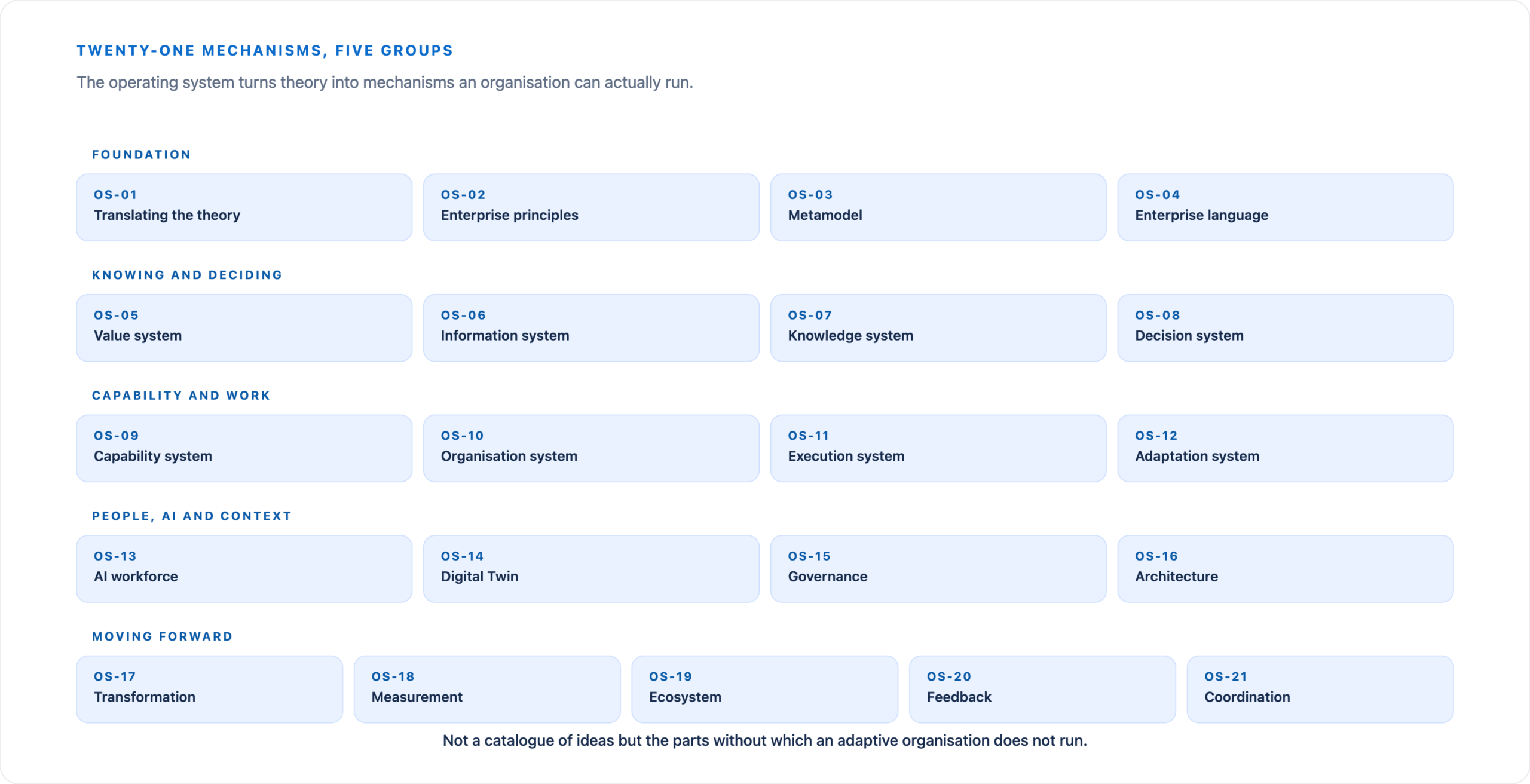
Chapter overview
What sits in which chapter
Foundation
- OS-01Translating the theoryTurns the basic terms into enterprise mechanisms you can apply.
- OS-02Enterprise principlesThe organisational, human, technical and adaptive principles.
- OS-03MetamodelEnterprise objects, relationships, states, events, behaviour, life cycles.
- OS-04Enterprise languageShared terminology, taxonomy and semantics for people, systems and AI.
Knowing and deciding
- OS-05Value systemPurpose, outcomes for stakeholders, priorities, measurable value creation.
- OS-06Information systemThe cognitive mechanisms and the relationship between human and artificial intelligence.
- OS-07Knowledge systemHow knowledge arises, is structured, governed, used and developed.
- OS-08Decision systemTransparent, traceable and governed decision paths.
Capability and work
- OS-09Capability systemCapability models, accountability, life cycle, portfolio, maturity.
- OS-10Organisation systemStructures, roles, teams, communities, networks, collaboration.
- OS-11Execution systemHow strategy, decisions and capabilities become processes and results.
- OS-12Adaptation systemImprovement, learning, transformation, innovation, resilience.
People, AI and context
- OS-13AI workforceThe integrated collaboration of people, AI workers and agents.
- OS-14Digital TwinThe dynamic digital representation of the organisation and its states.
- OS-15GovernanceDirection, risk, compliance, security, data protection, ethics, accountability.
- OS-16ArchitectureArchitecture as the structural representation of the adaptive enterprise.
Moving forward
- OS-17TransformationGoverned development of capabilities, knowledge, governance and intelligence.
- OS-18MeasurementKey figures, the state of the organisation, maturity, value measurement.
- OS-19EcosystemRelationships with partners, networks, platforms, markets, regulators.
- OS-20FeedbackHow internal and external signals become learning, decisions and adaptation.
- OS-21CoordinationAligning people, AI, teams, capabilities, resources and dependencies.
Onward in the framework
On to Management
The six building blocks build on one another. If you are done here, the sensible next read is there.