A copilot helps one person. A workforce carries the work.
Scattered assistants make individual people faster, but they do not make the organization better. In TAOM, AI agents get what every role needs: accountability, boundaries, and a human who remains responsible.
The difference
Why many assistants do not become a workforce
What happens in most organizations
Every department introduces its own assistant. Results end up in chat histories, nobody knows what they are based on, and two teams receive different answers to the same question.
The result is more speed with the same level of disorder.
Role definition
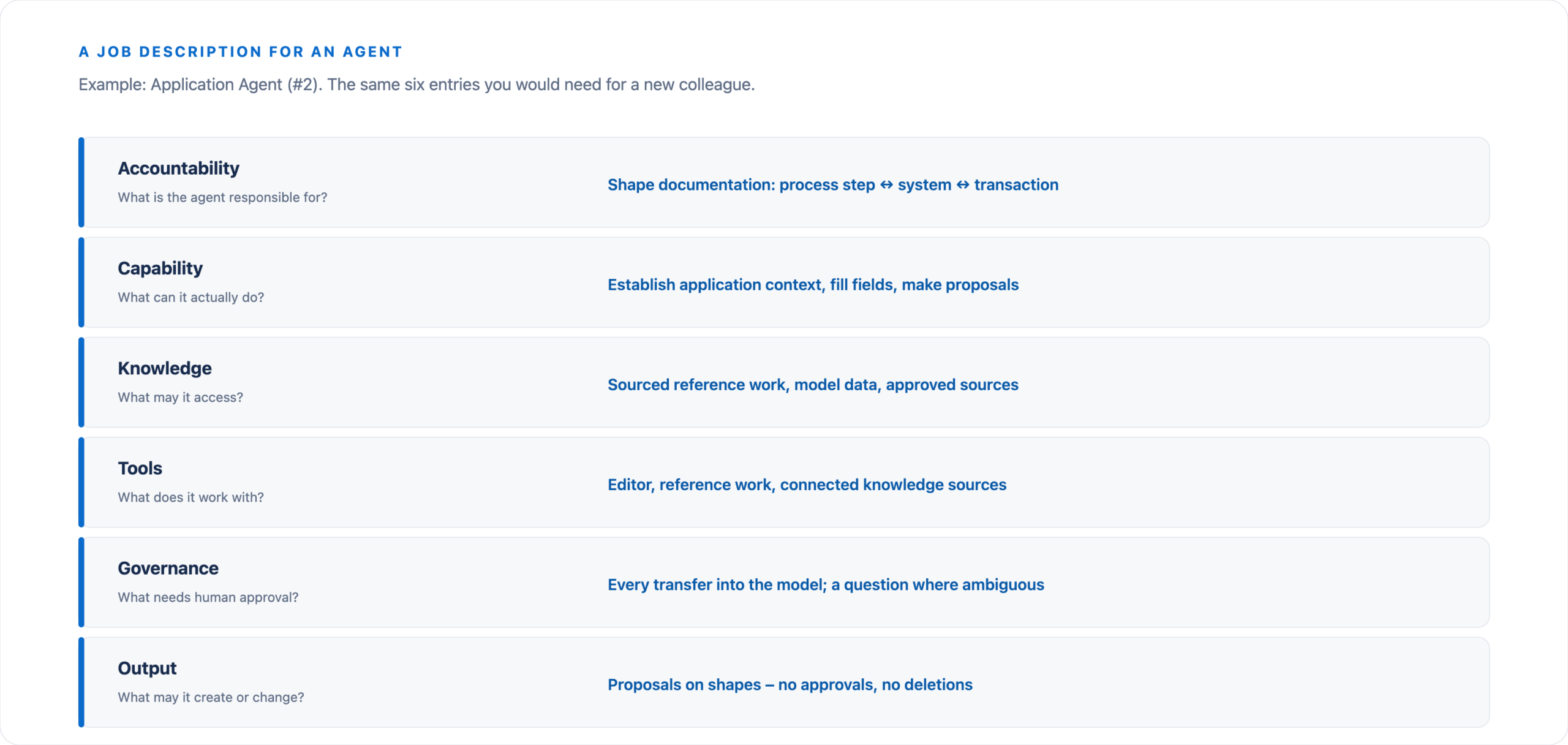
Six elements you would also clarify for a new colleague
When hiring a person, you clarify responsibilities, capabilities, access, tools, approvals, and expected outcomes. With an agent, these points are often skipped – and that is exactly where the problems begin.
Boundaries
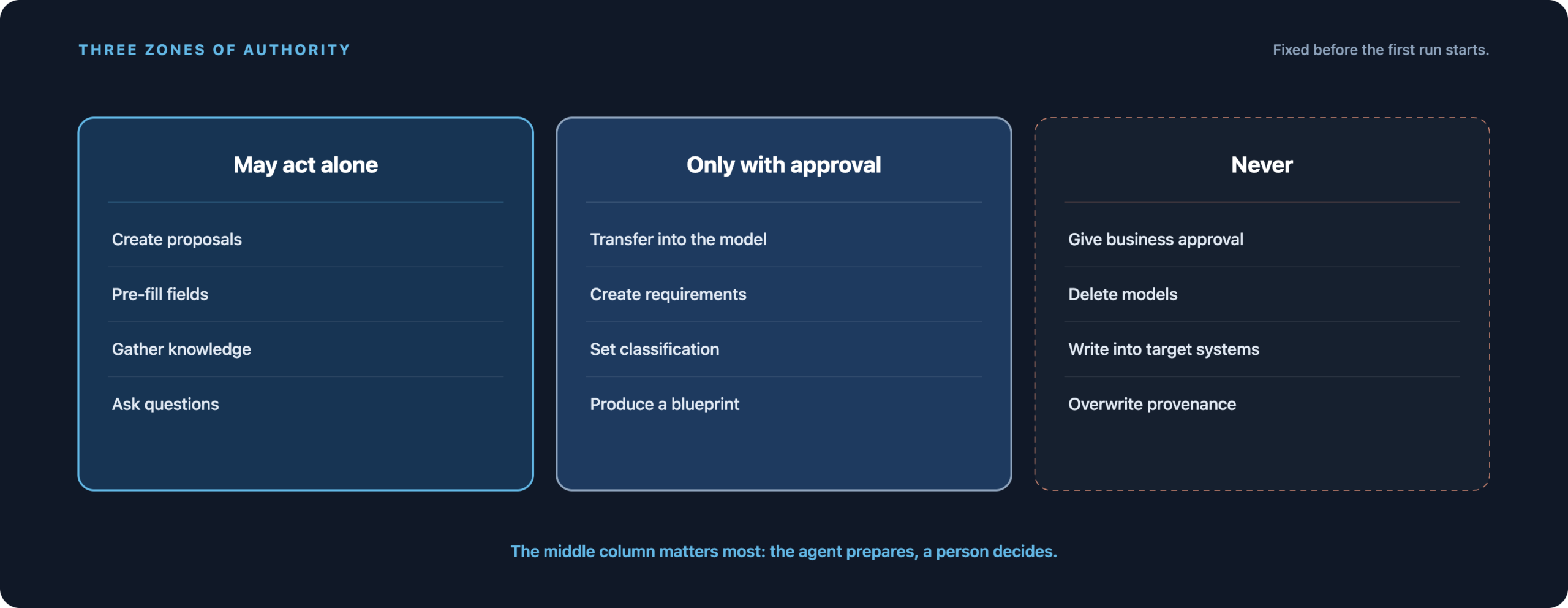
What an agent may do – and what it must never do
This classification is defined before the first run. It is what makes it possible to let agents work without giving up control.
Separation of responsibilities
Seven responsibilities instead of one general-purpose agent
An agent expected to do everything will be mediocre at everything. In TAOM, work is separated by level – each agent sees exactly the scope it is qualified to assess.
- #1Process AgentModel structure – diagram level.
- #2Application AgentProcess step ↔ system ↔ transaction – shape level.
- #3Quality AgentRequirements, risks, controls, tests – shape and process level.
- #4Knowledge AgentKnowledge from sources – shape and phase level.
- #5Delivery AgentEpics, stories, specifications – phase and process level.
- #6Collaboration AgentMeetings and minutes – process level.
- #7Learning AgentExplains content based on role – user level.
Introduction
How to build this without overengineering it
1 · Choose one task
Something recurring with a clear outcome – not the most difficult task in the organization.
2 · Define the role
Complete the six elements. If one remains unclear, the task is not defined well enough yet.
3 · Set boundaries
Define what may happen without approval – when in doubt, allow less.
4 · Run in parallel
The agent proposes, humans review. Accuracy becomes visible within days, not months.
5 · Refine the boundaries
What proves reliable may receive more authority. What does not gets tighter boundaries.
6 · Add the next role
Only then add the second responsibility.
Accountability
The question every works council and every auditor will ask
“Who is accountable for the outcome?”
The human who approved it. That is why final approval never sits with the agent, and why every artifact shows whether it was generated or modified by AI.
Provenance and approval are two different things – see Certification.
“Does this replace jobs?”
The answer is straightforward: it shifts work. What disappears is much of the copying, searching, and formatting. What remains is judgment – and there is usually more of that, not less.
Anyone presenting it differently will face the issue again in the very first workshop.
Getting started
Start with one responsibility, not with a strategy
Take one recurring task, define it like a role, keep the boundaries tight, and let the agent contribute while humans review.