TAOM™ AI Framework
Introducing tools is easy. Changing an organisation is not.
Most organisations start with individual AI tools – assistants, chatbots, automation, agents. That does not yet make an AI-native organisation. Das Framework beantwortet die grössere Frage: how should an organisation work in which people and AI act together?
- Theory
- Operating model
- Management
- Architecture
- Engineering
- Tooling
The difference
From introducing AI to adapting the organisation
What usually happens
- An assistant is rolled out
- A chatbot answers enquiries
- A workflow is automated
- An agent is piloted
Each initiative makes sense on its own – and yet the organisation works exactly as it did before.
What the question really is
How are decisions made when a machine has a say? Who owns a process an agent works on? How does the AI know what applies in the organisation? Who is accountable for a result nobody wrote?
Questions like these are answered by a body of knowledge, not by a tool.
The structure
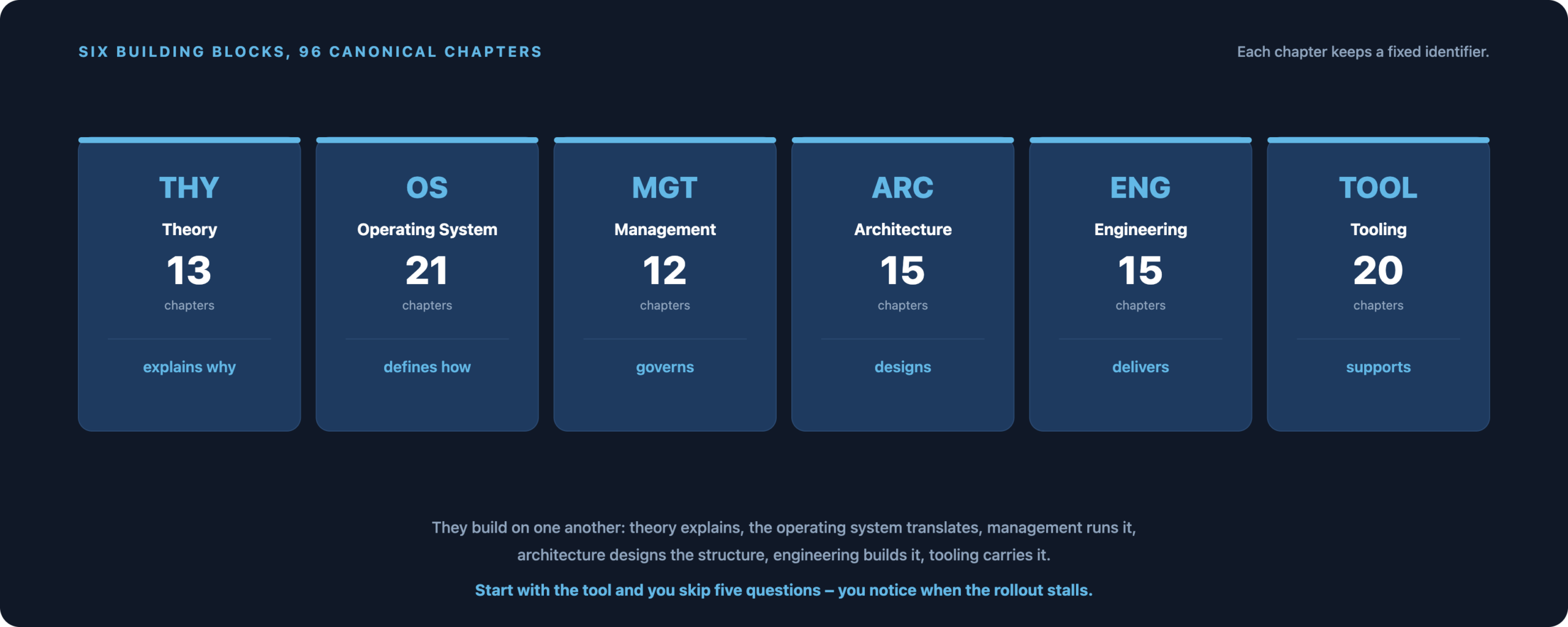
Six building blocks, 96 canonical chapters
Each building block has a task of its own – and each chapter a fixed identifier that can be cited permanently.
The six views
What sits in which building block
Fundamental questions on organisation, value, work, knowledge, intelligence, decisions, capabilities, learning, adaptation, governance and AI.
Open Theory → OSOperating System · 21 chaptersdefines howShared mechanisms: enterprise principles, metamodels, common language plus value, information, knowledge and decision systems.
Open Operating System → MGTManagement · 12 chaptersgovernsOperational management of strategy, organisation, capabilities, knowledge, decisions, processes, resources and performance.
Open Management → ARCArchitecture · 15 chaptersdesignsStructure: business, capability, information, data, application, integration, technology, AI, security and Digital Twin architecture.
Open Architecture → ENGEngineering · 15 chaptersdeliversAnalyse, design, implement, test and continuously improve – including planning, simulation and optimisation.
Open Engineering → TOOLTooling · 20 chapterssupportsDigital capabilities and platform requirements – written vendor-neutrally: the function is defined, not the product.
Open Tooling →Not a stack – a chain
The building blocks build on one another
Theory explains why organisations work the way they do. The Operating System translates that into an operating model. Management runs that model day to day. The Architecture designs the structure for it. Engineering builds and changes it. And Tooling beschreibt, welche technischen Fähigkeiten das trägt.
Starting with the tool skips five questions – and you only notice when the rollout stalls.
Living documentation
A body of knowledge that changes with you
The framework is not a manual published once. It grows in versions and traceably – with stable chapter IDs, so references do not expire.
The knowledge can be linked with reference processes, BPML, agent skill profiles, enterprise architecture, tool mapping, use cases and implementation notes – see Resources.
From knowledge to application
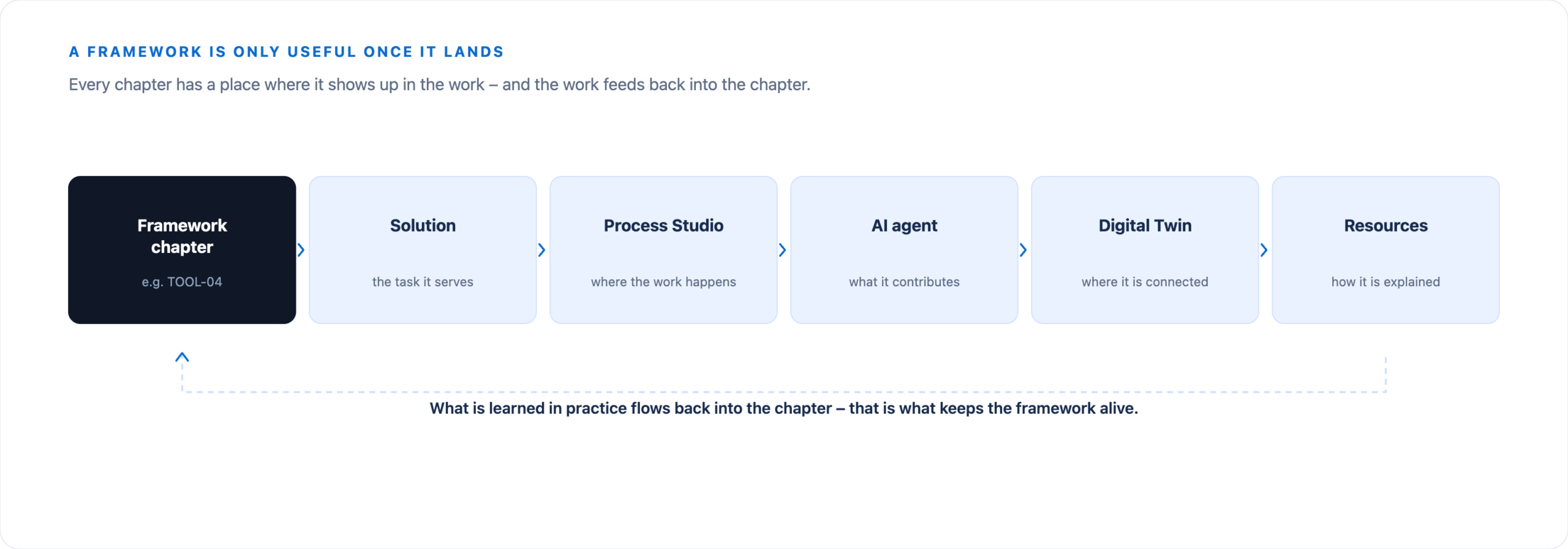
A framework is only useful once it lands
That is why the framework does not stand alone: every chapter has a place where it shows up in the work.
Where to start
Start with the view that matches your work
If you design structure, start with Architecture. If you deliver, with Engineering. If you govern, with Management. And if you want to know why it is all built this way, with Theory.