TAOM™ Collaboration
No one understands a process alone.
Some people know how the work actually gets done. Others understand the systems, the rules, or what needs to be built. Collaboration here does not mean moving boxes around together – it means bringing these perspectives together in the same model.
Who contributes
Eight perspectives on the same work
Each brings something the others do not have. That is why collaboration is not about who holds the pen.
The most expensive boundary
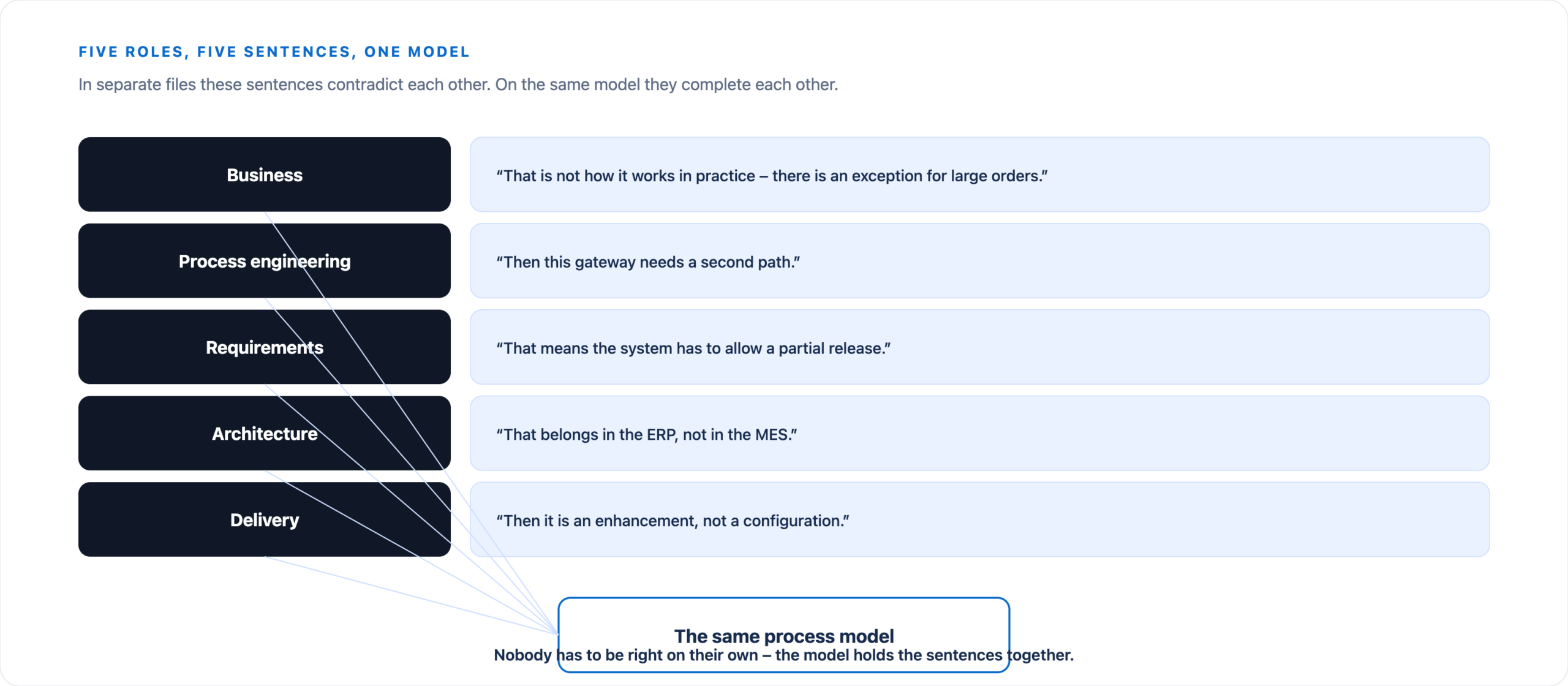
Business and technology talk about the same thing – just in different languages
Every role describes the same reality from a different perspective. As long as those statements live in separate files, they contradict each other. Attach them to the same model, and they begin to complement each other.
What really matters
Seven questions a team needs to answer
Sharing a file answers none of them. This is where drawing stops and real process work begins.
- What changed?
- Why was it changed?
- Who still needs to review it?
- Which requirement resulted from it?
- Which system is affected?
- Which information came from AI?
- Which version is currently authoritative?
AI has a seat at the table
A proposal is not an approval
Collaboration no longer happens only between people. What matters is that AI involvement remains visible – otherwise, you end up with a result that nobody can explain.
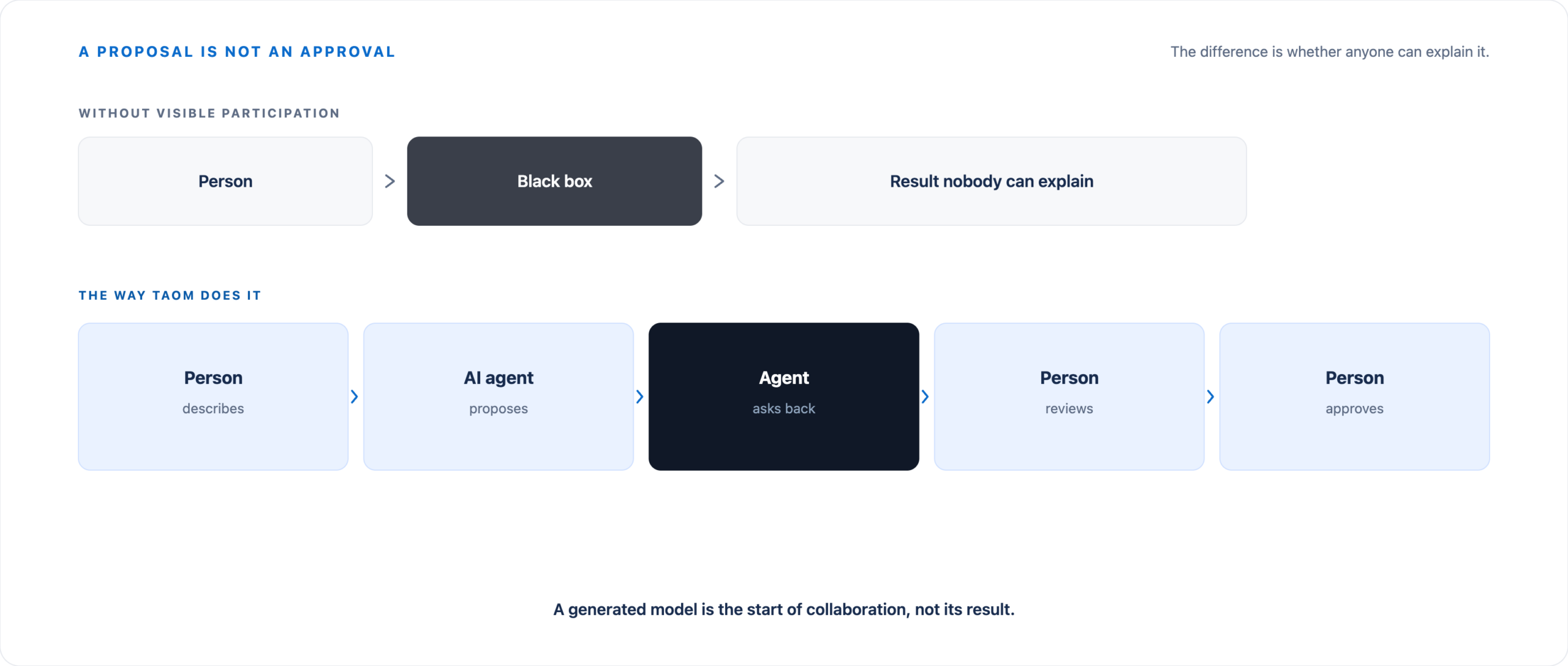
An AI-generated model is the beginning of collaboration, not its final result. The path is:
- AI Proposal
- Business Review
- Process Review
- Technical Enrichment
- Governance Review
- Approval
Everyone contributes their expertise without losing the original context – learn more about the Agents.
What is available in the tool today
A transparent view of the current state
Presence: who is currently working on what
The Editor shows who is in the same workspace and what they are working on. This is intentionally Stage One: activity is reported and displayed only – nothing is locked and nothing in the model is changed. This prevents work from being lost while collaborative working practices are being established.
Presence signals remain active for twenty seconds and expire automatically. When someone closes the browser, they disappear – avoiding a manual sign-out mechanism that could easily be forgotten.
Shared workspace, history, and audit trail
The process model, business descriptions, roles, systems, phases, requirements, classifications, WRICEF information, delivery data, and governance information are kept in the same place – attached to the relevant element rather than distributed across separate files.
History and the audit trail can be displayed to make the evolution of the model transparent.
Original and working version side by side
The unchanged source file remains on the left, while the version being worked on is shown on the right. This makes two questions that constantly arise during a transformation initiative easy to answer: Where did we start? And what has changed since then?
The provenance seal adds another layer of transparency – documenting what was generated by AI and what was modified within TAOM.
What is still missing
Concurrent editing of the same element with locking, Shape-level comment threads, and a formal approval workflow with assignments and reminders have not yet been implemented.
The sequence is deliberate: first show who is present, then enable simultaneous editing. A locking mechanism that causes work to be lost would be worse than having none.
Instead of seven repositories
One connected context, not six separate files
What it usually looks like
The process model is in one file. Requirements are in a spreadsheet. The backlog is in the delivery system. Specifications are in documents. Meeting notes are in email. The architecture diagram is in a presentation. The AI conversation sits in a chat window.
Each one may be correct on its own – but together they do not provide a coherent picture.
What TAOM is working toward
The tools can remain. What becomes visible is how their information is connected – using the process as the shared point of reference.
Collaboration therefore becomes part of the Digital Twin rather than a separate feature alongside it.
Getting started
Take one process and bring the right people together
Start with a process that someone already needs to explain. Bring in the people who know it. Let AI do the groundwork where it saves time. Then review the result together.