Creating the artefacts is not the problem. Keeping them connected is.
Best practices, workshop outcomes, fit-to-standard decisions, variants, requirements, gaps, WRICEF objects, specifications, tickets, test cases, documentation. Each one is fine on its own – but in the end, nobody knows why something was built.
The core
From the standard to your own solution – traceably
An SAP project starts with the business process and very quickly moves on to applications, configuration and development. TAOM keeps the business-related starting point visible.
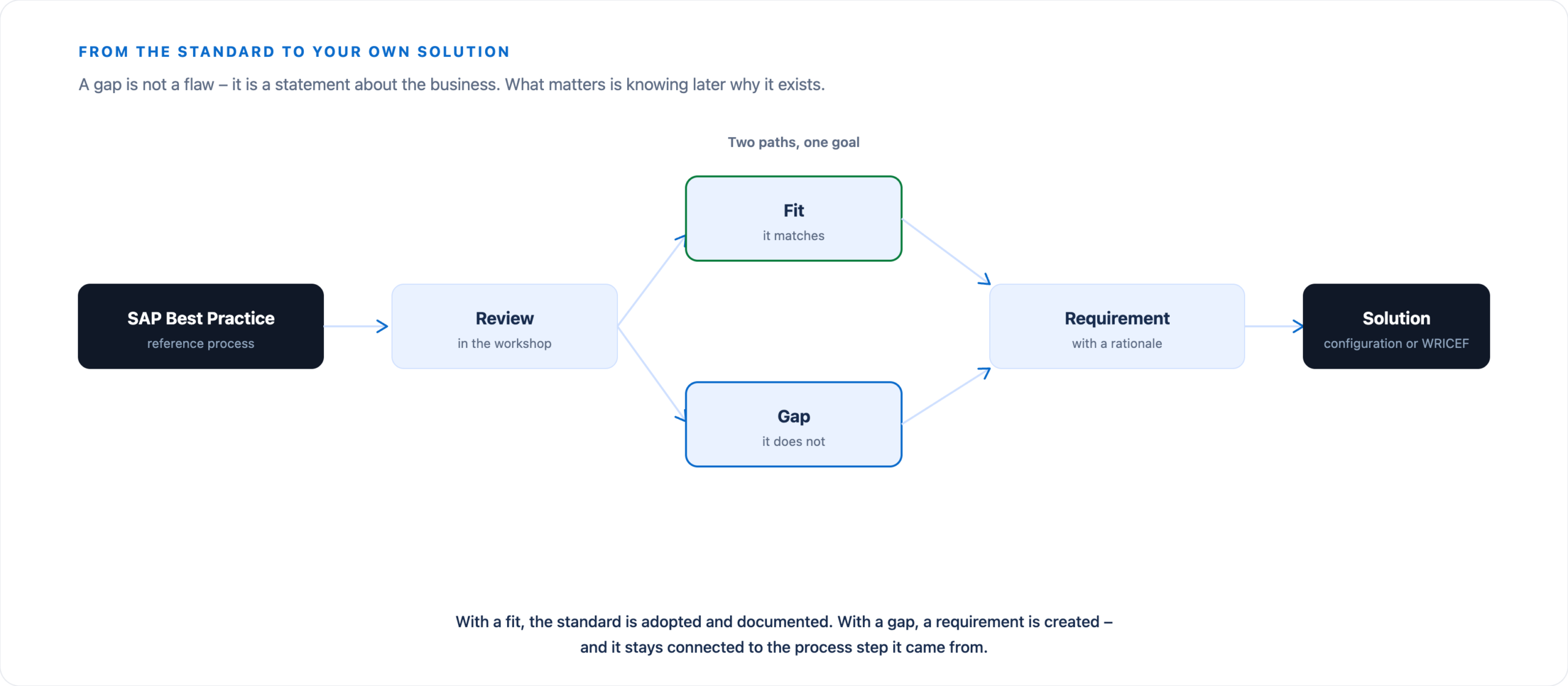
Fit-to-Standard
A workshop outcome is more than just minutes
What is discussed in the workshop
- 01What fits?
- 02What doesn’t fit?
- 03What organisational differences are there?
- 04What system changes are required?
- 05Which interfaces are affected?
- 06Which reports or forms are missing?
Where it belongs
These answers are linked to the process step in which they arose – not stored in a file with the workshop date in its name.
The minute entry becomes enterprise context that still makes sense six months later.
WRICEF
Development objects with provenance
Custom developments are usually kept separately from the process model. In TAOM, they are linked to the activity and the requirement from which they originated.
Workflow
Sequences steered inside the system.
Report
Reports and lists.
Interface
Interfaces to other systems.
Conversion
Data takeovers and migration.
Enhancement
Extensions to the standard.
Form
Forms and documents.
The abbreviation is not important – depending on the project, different classifications may be used. What matters is traceability: business need → requirement → development object → delivery.
Scope
Signavio can stay where it is
If you run an established process platform, you do not have to replace it. TAOM sits alongside it and supplies what is missing between discovery and delivery.
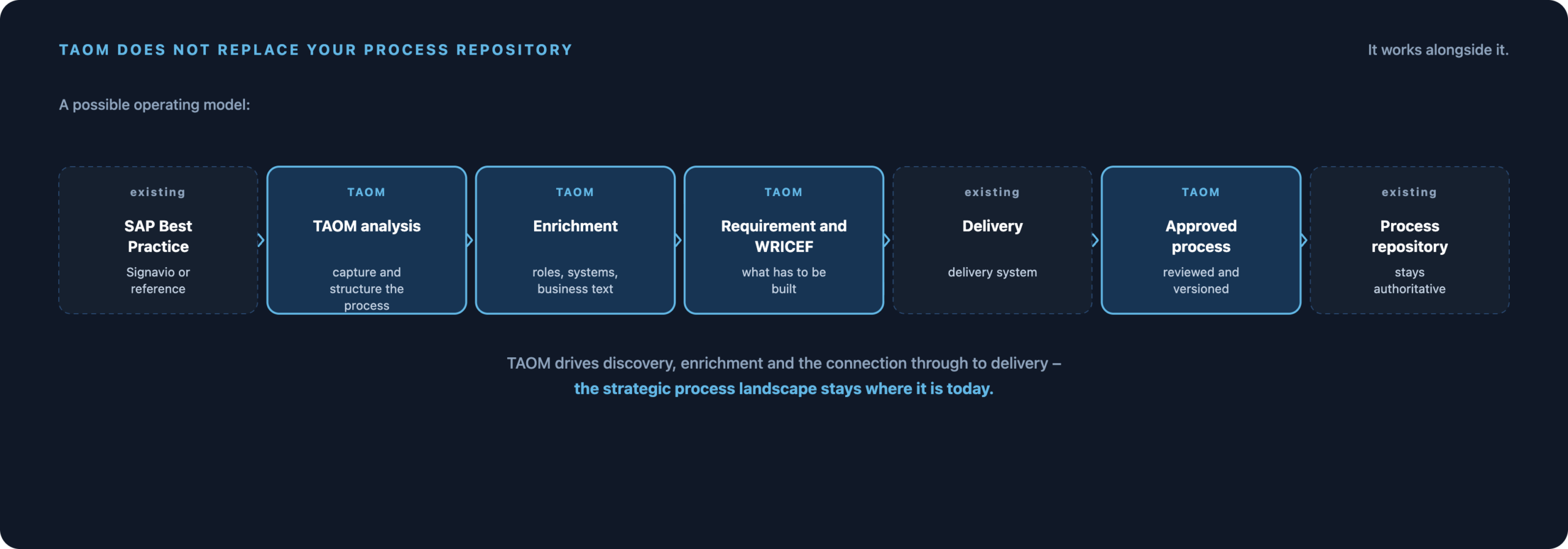
Through to evidence
Test against the business need
The chain right up to approval
- 01Process
- 02Requirement
- 03Implementation
- 04Test requirement
- 05Test case
- 06Result
- 07Approval
Why this matters
Otherwise you test against the specification – that is, against what someone has written down, not against what was actually needed. If the chain remains connected, both can be verified.
At the acceptance meeting you can then show which business need is covered by which test case.
Typical projects
Where this is used
- 01S/4HANA transformationGreenfield and brownfield alike, with a traceable comparison against the standard.
- 02Global template programmesOne core, many countries – deviations justified rather than tolerated.
- 03Fit-to-Standard workshopsResults land on the process step instead of in the minutes.
- 04Process harmonisationMake variants visible before merging them.
- 05WRICEF managementDevelopment objects with provenance and priority.
- 06Testing and validationFrom the business need through to the evidence.
Getting started
With a process from the project you are already running
Take a workflow that is up for fit-to-standard anyway. Capture it, hold it against the standard, name the gap, derive the requirement – and see whether the connection holds.