Before building an Operating Model, thirteen questions need to be answered.
Theory is the part people like to skip – and later discover they are missing. It clarifies what an Organization actually is, what Value, Work, Knowledge, and Decision mean, and what changes when AI becomes part of the work. Every other building block is derived from these foundations.
Why Theory
Without a shared language, everyone is talking about something different
The common mistake
Transformation initiatives talk about “Processes”, “Roles”, “Capabilities”, and “Decisions” as if everyone agreed on what they mean. They do not. Two departments may understand the same Capability differently – and nobody notices until the Solution Design no longer fits.
AI makes this problem more significant: a machine cannot infer terminology that the organization itself has never defined.
What Theory provides
It defines the fundamental concepts once, consistently, and for everyone – readable by humans and AI systems alike. This makes everything that follows derivable rather than repeatedly negotiable.
One guiding principle runs throughout: Value is created by people. Technology amplifies their capabilities, AI augments them, and Management enables them.
The fundamental questions
Thirteen chapters, twelve questions, and one synthesis
Each chapter answers one fundamental question. The thirteenth brings the previous twelve together into a Theory of the Adaptive Enterprise.
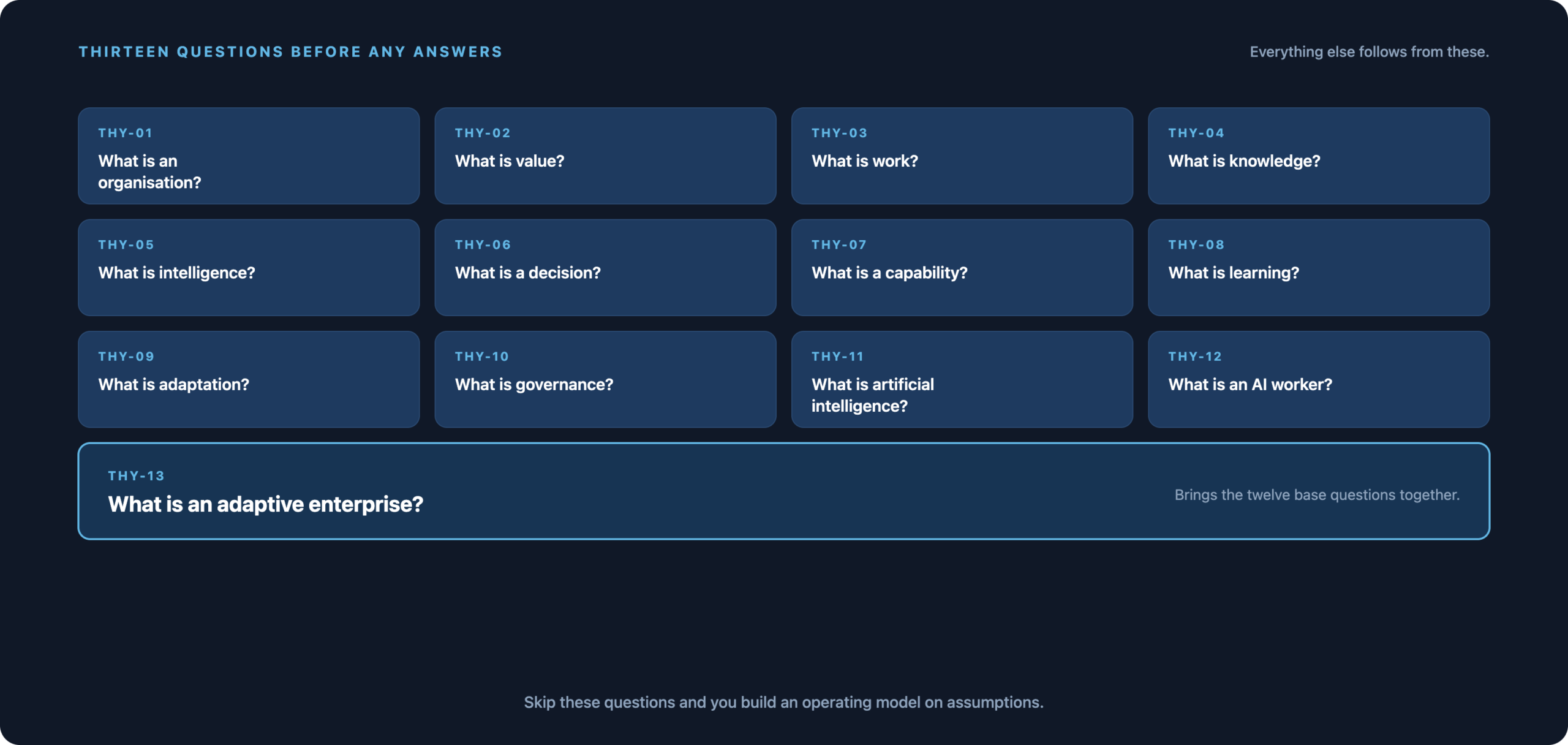
Chapter Overview
What each chapter establishes
- THY-01What is an Organization?Organizations as adaptive sociotechnical systems composed of People, Knowledge, Decisions, Capabilities, Technology, and AI.
- THY-02What is Value?Value Creation across Stakeholder Value, Customer Value, Human Value, Organizational Value, Societal Value, and Knowledge Value.
- THY-03What is Work?Work independent of jobs and departments: purposeful execution by Humans, Machines, and AI Workers.
- THY-04What is Knowledge?Knowledge as a core organizational resource and the foundation for Organizational Memory and Organizational Learning.
- THY-05What is Intelligence?Human, Collective, Organizational, and Artificial Intelligence considered together.
- THY-06What is a Decision?The mechanism through which Knowledge is translated into Action and Outcomes.
- THY-07What is a Capability?Capabilities as stable building blocks connecting Strategy, Value Creation, Organization, and Change.
- THY-08What is Learning?Human Learning, Organizational Learning, Machine Learning, and adaptive learning mechanisms.
- THY-09What is Adaptation?Adaptation, Resilience, Evolution, Transformation, and Continuous Improvement.
- THY-10What is Governance?The coordinated governance of Decisions, Behavior, Authority, Accountability, and Control.
- THY-11What is Artificial Intelligence?AI from an organizational and enterprise perspective rather than a purely technical one.
- THY-12What is an AI Worker?Governed computational actors operating within clearly defined boundaries of Authority, Knowledge, and Control.
Where Theory becomes practical
Theory is not an end in itself
In the Operating System
OS-01 translates these foundations into operational mechanisms – Explore the Operating System.
In the AI Workforce
THY-12 provides the foundation for managing Agents as organizational Roles rather than treating them merely as tools – Explore the Agents.
In the Glossary
The concepts reappear as defined terms with connected references – Explore the Glossary.
Continue through the Framework
Continue to the Operating System
The six building blocks build on one another. Once you have completed this section, the Operating System is the logical next step.