TAOM™ Engineering
Architecture defines what should exist. Engineering makes it happen.
In most transformation initiatives, there is a gap between business design and implementation: Business describes the processes, Architecture designs the target state, Requirements Management writes specifications, and Development receives tickets. Context is lost at every handover.
The missing bridge
Six stakeholders, six repositories
Every group works professionally – but in its own tool. What gets lost is not diligence, but the connecting thread.
- Business describes the processes
- Architecture designs the Target Architecture
- Requirements Management writes specifications
- Development receives tickets
- Testing creates test cases
- Documentation is created alongside the work
From Process to Implementation
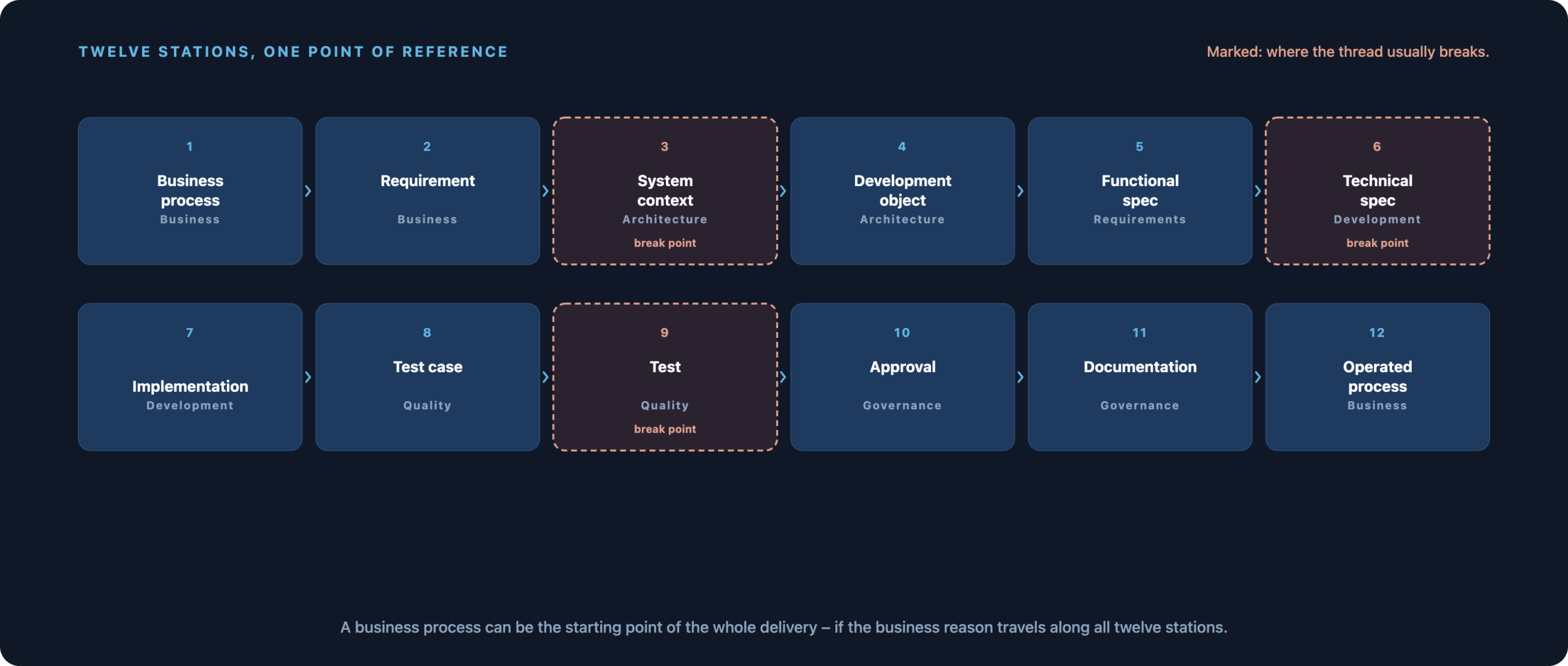
Twelve stages, one point of reference
A business process can serve as the starting point for the entire implementation – if the business rationale remains connected across every stage.
Five disciplines
What Engineering covers in TAOM
Understand how work gets done
- Process Discovery
- BPMN Modeling
- Analysis and Design
- Roles and Responsibilities
- System Mapping
- Process Requirements
- Process Governance
The workspace for this is the Process Studio.
Turning business needs into structured change
A Requirement remains connected to what it originated from: Process, Process Step, Role, System, Business Objective, and Development Context.
This creates end-to-end traceability from the change back to its rationale – and from the rationale forward to what is being built.
Turning Requirements into implementable solutions
- Configuration and Extensions
- Workflows, Reports, Interfaces
- Migrations, Enhancements, Forms
- Integration and Automation
- AI Capabilities
In SAP and enterprise transformation initiatives, this translates into WRICEF classification.
Governed capabilities instead of isolated experiments
- Agent Role
- Capability
- Knowledge
- Model
- Tool
- Process
- Governance
- Oversight
This is how an AI Capability becomes part of the organization rather than an experiment alongside it – learn more about the Agents.
No system operates in isolation
- Process Platforms and ERP
- Delivery Platforms
- Knowledge Platforms
- Enterprise Architecture
- Automation and AI Services
The current integration scope is documented transparently under Integrations.
Validation
A Test must remain connected to the Requirement and Process it validates – otherwise, nobody will know later what was actually verified.
- Process
- Requirement
- Implementation
- Test
- Result
- Approval
Seven questions about AI
What must be clarified before anything is built
AI introduces questions that traditional implementation planning does not address. They belong in Solution Design, not in final acceptance.
- Which tasks should AI support?
- Which Agent is responsible?
- Which Knowledge may it access?
- Which Tools may it use?
- Which Decisions may it make?
- When is Human Approval required?
- How is its activity monitored?
Governance by Design
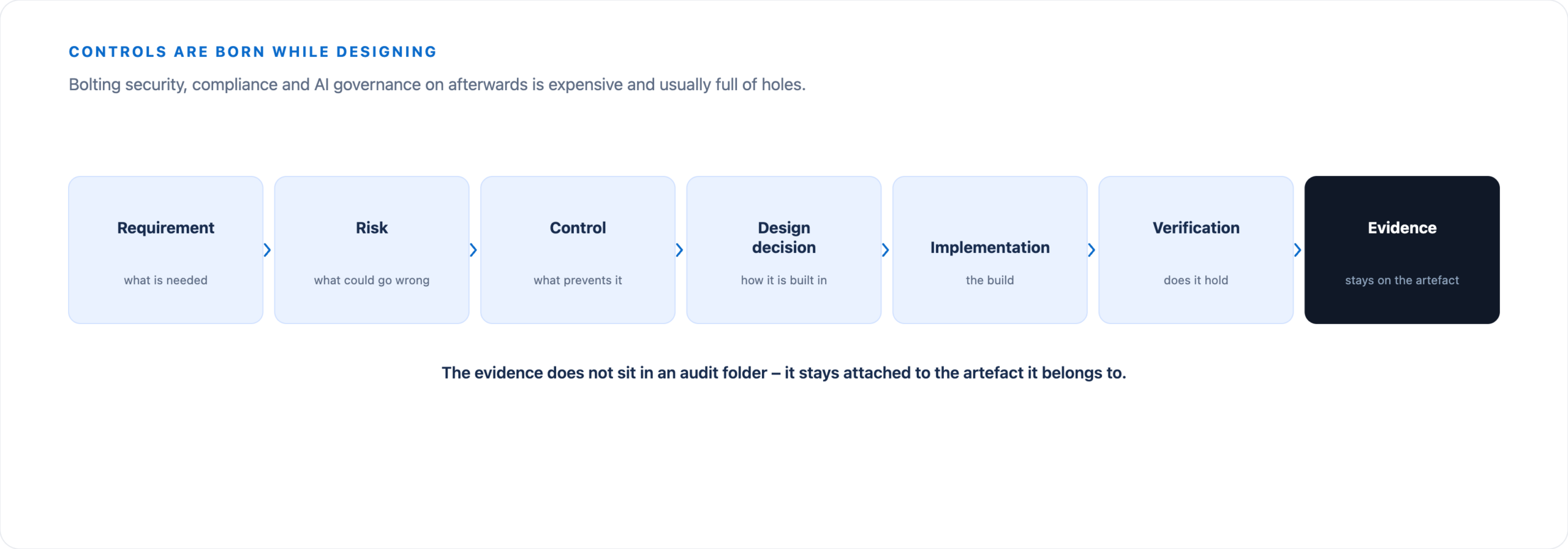
Controls are designed from the start
Adding Security, Compliance, and AI Governance after implementation is expensive and usually incomplete. Engineering identifies and incorporates them while the solution is being designed.
Delivery is not the end
Engineering is a continuous cycle
Operations generate new insights, processes evolve, new Requirements emerge, and AI Capabilities improve. Engineering therefore does not stop at deployment.
- Discover
- Design
- Build
- Validate
- Deploy
- Observe
- Learn
- Adapt
Architecture
defines the structure that should be created – learn more.
Engineering
builds and evolves the capabilities.
Digital Twin
keeps the result connected – learn more.
In practice
Where Engineering becomes tangible
These disciplines are not an end in themselves. Within Solutions they come together in real transformation initiatives:
Getting started
From understanding to an operating organization
Understand the Process. Design the Structure. Build the Change. Validate the Outcome. Connect the Knowledge. Learn from Operations. And keep adapting.