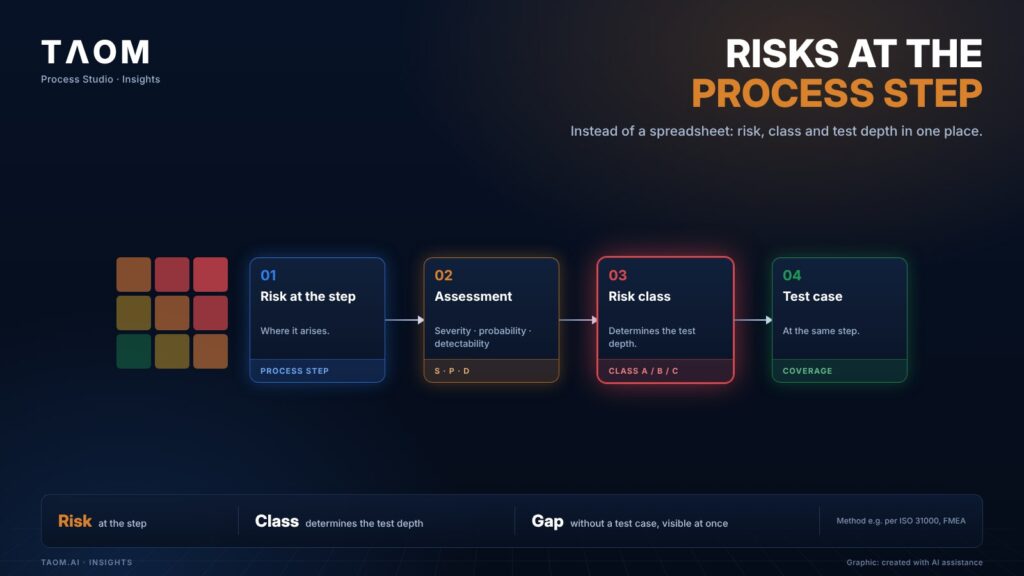
In many projects, the risk register lives in one spreadsheet, the test cases in another tool and the process in a third. Then nobody can tell at a glance whether a critical step has been tested.
The method is well known
Whether ISO 31000, FMEA or GAMP 5 in regulated environments: risks are identified, assessed, treated and monitored. The problem is rarely the method, but the link to the process.
Briefly explained: FMEA (failure mode and effects analysis) asks what can go wrong, how serious it would be and whether it would be noticed in time. GAMP 5 is a guide for computerised systems in regulated industries such as pharmaceuticals and medical technology; ICH Q9 describes quality risk management in the pharmaceutical industry. TAOM does not prescribe a method – it is chosen per risk.
Risk, class, test depth
In TAOM, the risk is attached to the process step. Severity, probability and detectability give the risk class – and the risk class determines the test depth. Controls can be stored for each risk; the risk register shows the coverage.
Gaps are visible at once
A test-relevant step without a test case is immediately visible in the diagram. If a step changes, Change Impact shows which risks need to be reassessed.
Across all models, the attribute directory answers the same question with one click: “risk without control” or “test-relevant but without a test case”. In regulated environments, equipment qualification is added (IQ, OQ, PQ) – also at the step.
A risk that is not attached to the process gets assessed – but not managed.
In short
If you link risk, test case and process step, you can see at a glance where it is critical, how deeply you need to test and where a test is still missing.
About TAOM: TAOM is the method and platform of Traniva AG (Switzerland) for people, processes and AI working together – with Process Studio Editor and Viewer, TAOM Training and Support. Our principle: AI supports, responsibility stays with people.
Read more: Testing and verification · Change Impact Management · Learning video: Assessing risks in the process
Leave a Reply