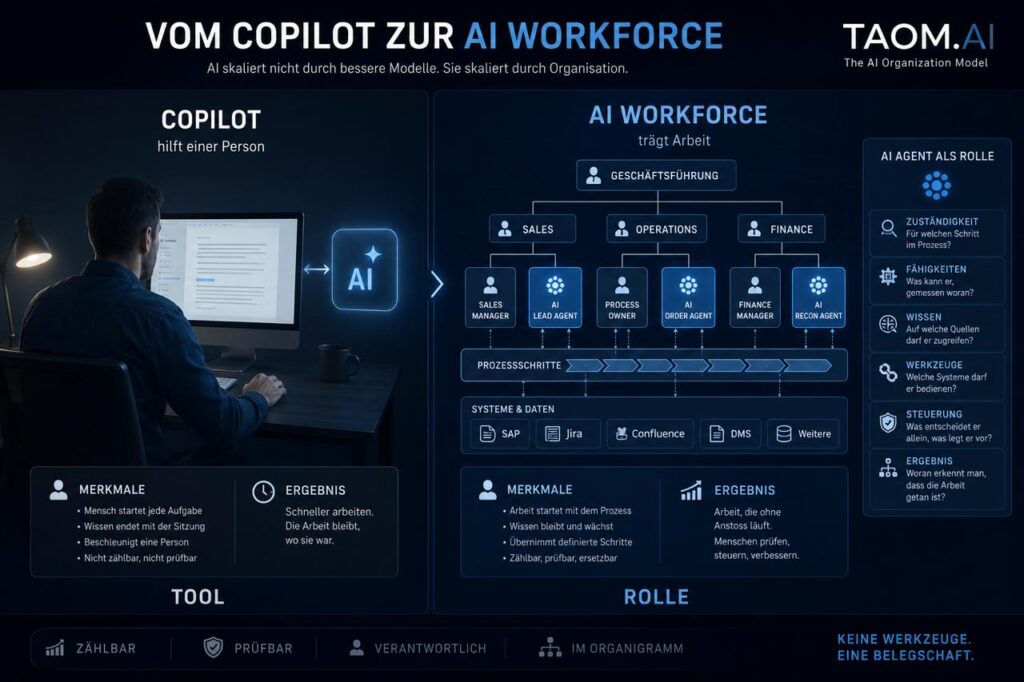
A copilot helps one person type faster. A workforce carries work. The difference is not a question of model quality – it is a question of organisation.
What a copilot actually delivers
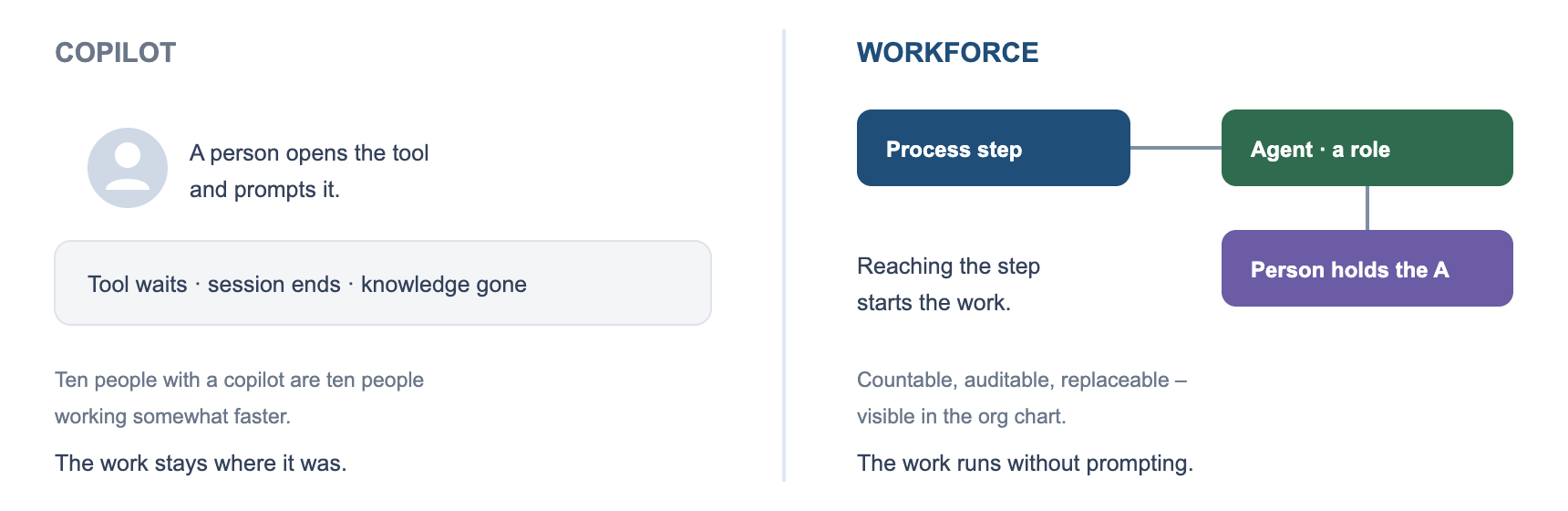
A copilot sits next to a person and waits. It knows the open document, perhaps the last few messages, sometimes a connected system. It suggests, rephrases, summarises. Then the session ends, and the knowledge with it.
That is useful and it pays for itself – but it does not scale. Ten employees with a copilot are ten employees working somewhat faster. The work itself stays where it was.
A copilot speeds up a person. It does not take on a task.
Why this is not a question of better models
The obvious thought is: once the model is good enough, it will take on more by itself. That is a mistake, and an expensive one.
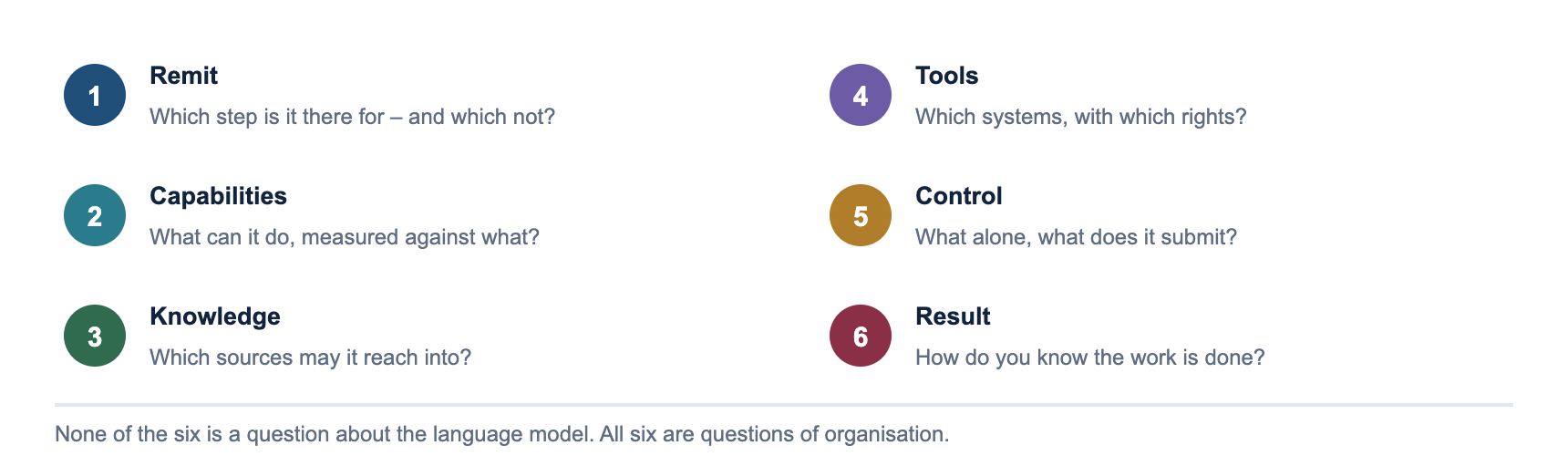
For anyone to take on a task – human or machine – six things must be settled. With a new employee we settle them in passing over the first few weeks. With an agent nobody settles them, because nobody feels responsible.
The six statements
| Statement | The question behind it |
|---|---|
| Remit | Which step in the process is it there for – and which not? |
| Capabilities | What can it do, measured against what? |
| Knowledge | Which sources may it reach into? |
| Tools | Which systems may it operate, with which rights? |
| Control | What does it decide alone, what does it submit? |
| Result | How do you recognise the work is done? |
None of these questions has anything to do with the language model. All six are questions of organisation – and that is exactly why copilots get stuck.
The move: agent as a role, not as a tool
A tool is used. A role is filled. The difference sounds academic, but it decides everything that follows.
Run an agent as a role in the operating model and you can hang it where the work arises: on a process step, in an organisational unit, with a role under RACI. It becomes countable, auditable, replaceable.
The practical test: Can you look in your org chart and see how many agents are deployed and who answers for them? If not, you have tools, not a workforce.
What changes as a result
The work leaves the inbox
With a copilot every task begins with a human starting it. With a workforce it begins when a process step is reached. That is the real jump: not faster work, but work that runs without being prompted.
Responsibility stays with people
An agent carries no accountability. It can execute, it can be consulted, it can be informed – it cannot decide. Whoever deploys it answers for the deployment.
An agent does not confirm itself. Its owner answers for the deployment.
That is not a legal precaution but a precondition for someone stepping in when something goes wrong.
The works council asks the right question
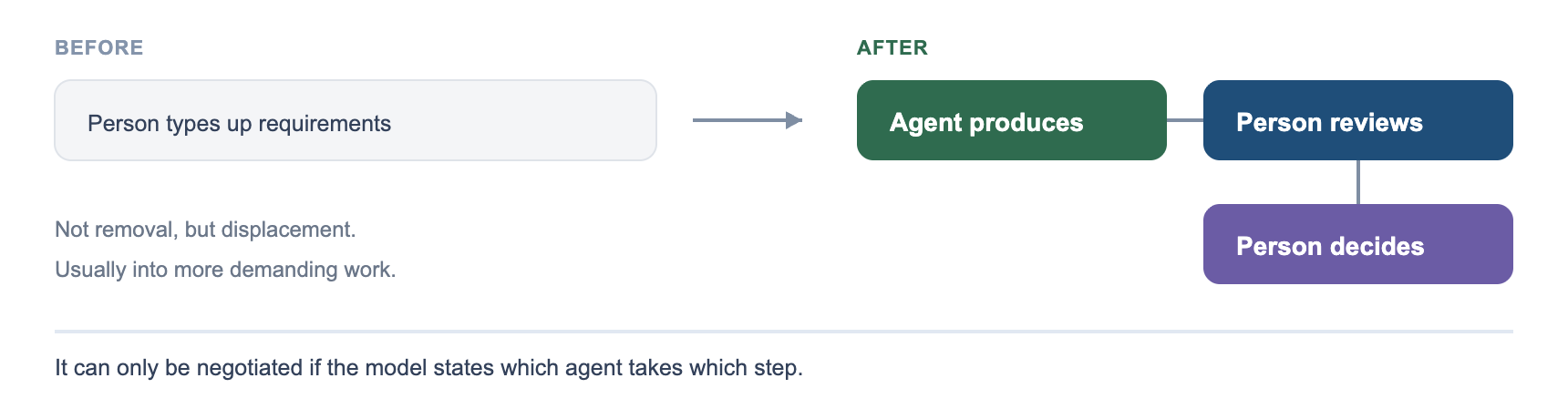
The most common question is: does this replace jobs? The honest answer is: it shifts them. Whoever types up requirements today will tomorrow review what an agent produced. That is different work, usually more demanding work.
This shift can only be negotiated if it is visible – that is, if the model states which agent takes which step. A copilot everyone uses quietly escapes co-determination entirely.
Where you start
Not with a platform. With a single step that occurs often enough to be worth it and is clear enough to describe.
Write down the six statements for that one step. If you cannot, the step is not ready – and no model in the world changes that.
In short
The path from copilot to workforce does not run through better models but through a settled remit. An agent run as a role is countable and auditable. An agent that is merely used stays a faster tool.
Read on:
TAOM AI Workforce ·
Escalation and AI agents ·
Responsibility & project organisation
Leave a Reply