TAOM AI Agents™
Seven specialists instead of one generalist.
Rather than one general assistant for every task, TAOM uses specialised agents with defined accountability – each at the level it can oversee, and all in the same enterprise context.
- Specialised
- Shared context
- People decide
Plain language is enough
Explain, don’t prompt
People who know a process describe it correctly by themselves – in full sentences, not in instructions to a machine.
“A customer places an order. Sales checks availability. If the product is not in stock, the demand goes to production. Before dispatch, quality assurance inspects the finished goods.”
From these four sentences the agent reads out structure:
- Activities
- Roles
- Decisions
- Systems
- Business objects
- Requirements
- Dependencies
Nobody has to learn BPMN first. Spoken language, workshop notes and work instructions are valid input too.
The seven agents
No one has to know everything
Each agent works at a particular level: the diagram, the single shape, the phase, the whole process – or the person sitting in front of it.
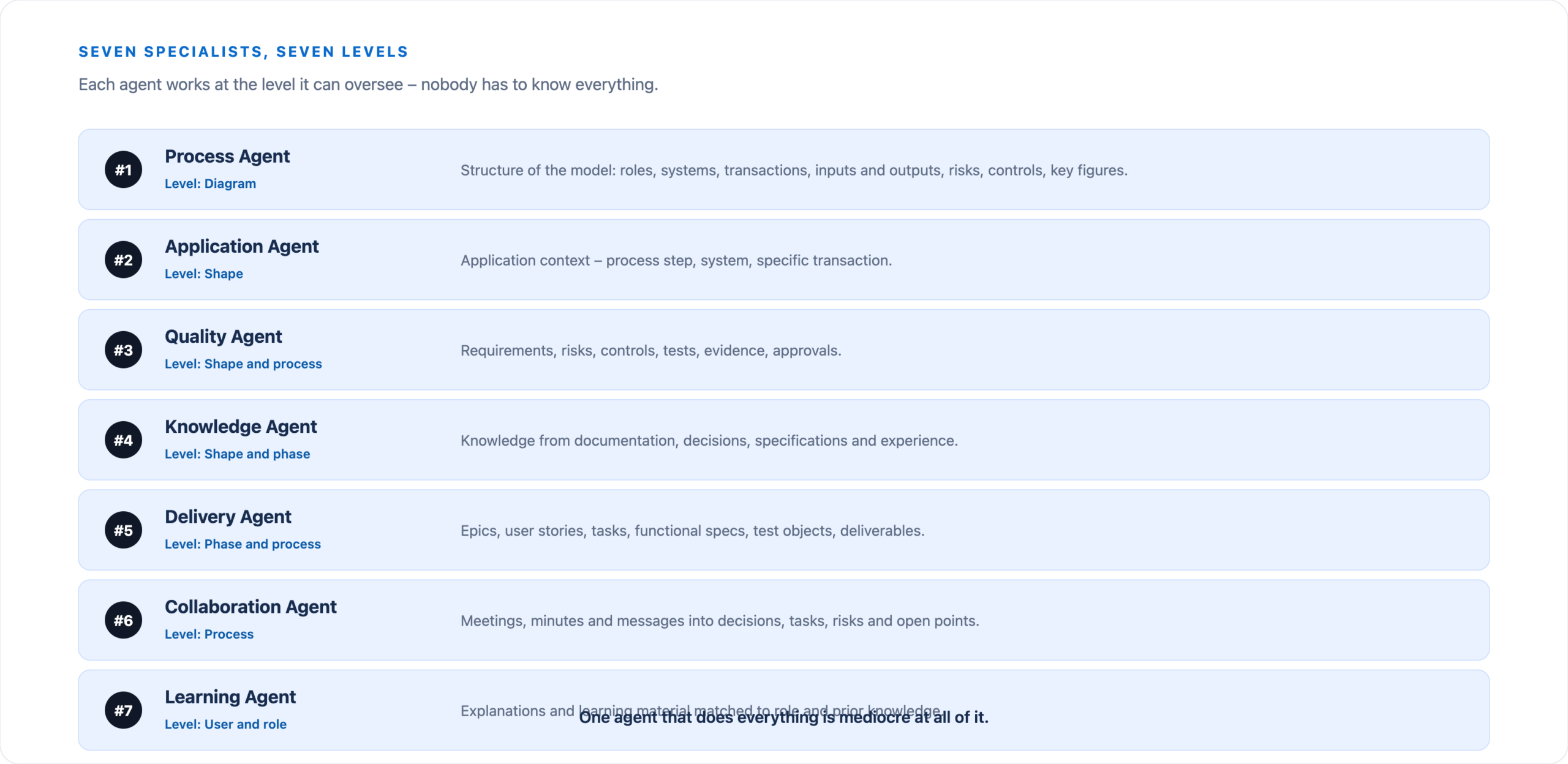
Process Agent
Builds the structure of the model: roles, systems, transactions, inputs and outputs, risks, controls, key figures.
Application Agent
Establishes the application context – process step ↔ system ↔ specific transaction. Vendor-neutral unless a supplier has been explicitly approved.
Quality Agent
Per step: requirements, risks, controls, tests, evidence, approvals. Also watches neutrality, so it does not rate suppliers.
Knowledge Agent
Finds and organises knowledge from documentation, decisions, specifications and experience – from Confluence or SharePoint, for example.
Delivery Agent
Turns business needs into epics, user stories, tasks, functional specifications, test objects, dependencies and deliverables.
Collaboration Agent
Reads meetings, minutes and messages and moves confirmed decisions, tasks, risks and open points into the target systems.
Learning Agent
Adapts explanations, guides and learning material to role, prior knowledge and working situation.
Orchestrated, not stacked
The Process Agent does not have to do the Delivery Agent’s work, and the Delivery Agent does not have to become an SAP specialist. All of them contribute to the same context.
Assignment
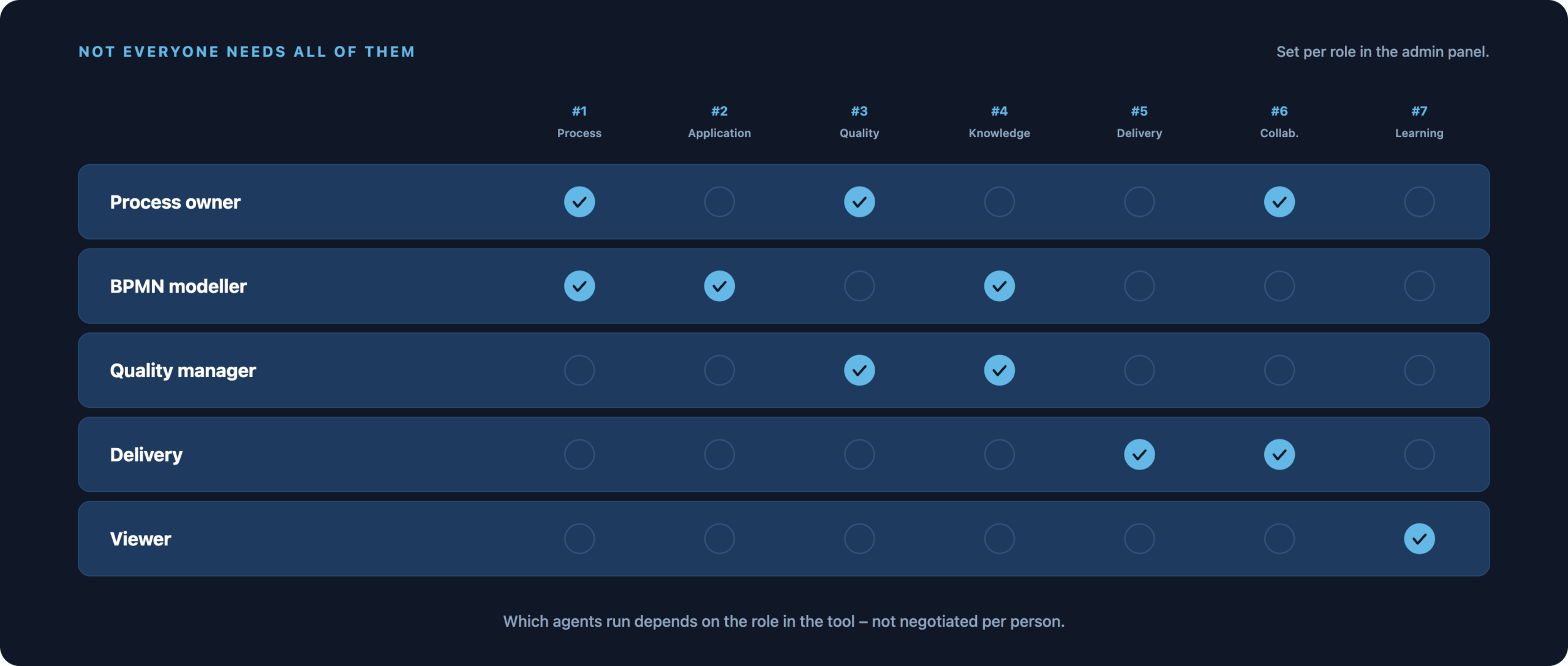
Not everyone needs all of them
Which agents work depends on the role in the tool – configured in the admin panel, not negotiated per person.
Context instead of prompt
Better surroundings, better answers
A general assistant starts at an input line. An agent inside an organisation should know more before it begins. TAOM can hand it:
- Process
- Process hierarchy
- Role
- System
- Requirement
- Business description
- Process phase
- Classification
- WRICEF object
- Governance fields
- Knowledge link
- Delivery fields
That lets an agent work within the organisation’s context instead of treating every request as a detached conversation.
Accountability
The agent proposes, the human is accountable
Questions instead of invention
Where a description is ambiguous – several independent workflows with no visible connection, for instance – the agent does not keep building on assumption. It asks a question with concrete options.
Question and answer remain readable in the history. That makes it possible to see later on what basis a model was created.
You decide how long it waits
The admin panel holds a grace period. Leave the field empty and the editor waits indefinitely for the answer – which keeps the decision explicitly with people.
A number in it means the agent carries on after that time. That is deliberately configurable and not the default.
From assistant to workforce
Six entries turn a helper into a role
An assistant helps one person. An AI workforce carries the organisation’s work – and for that, every agent needs the same entries a job position would have.
Getting started
With one process and one agent
Describe how the workflow runs. Have it structured. Look at the result. And only then add further agents, knowledge sources and context.