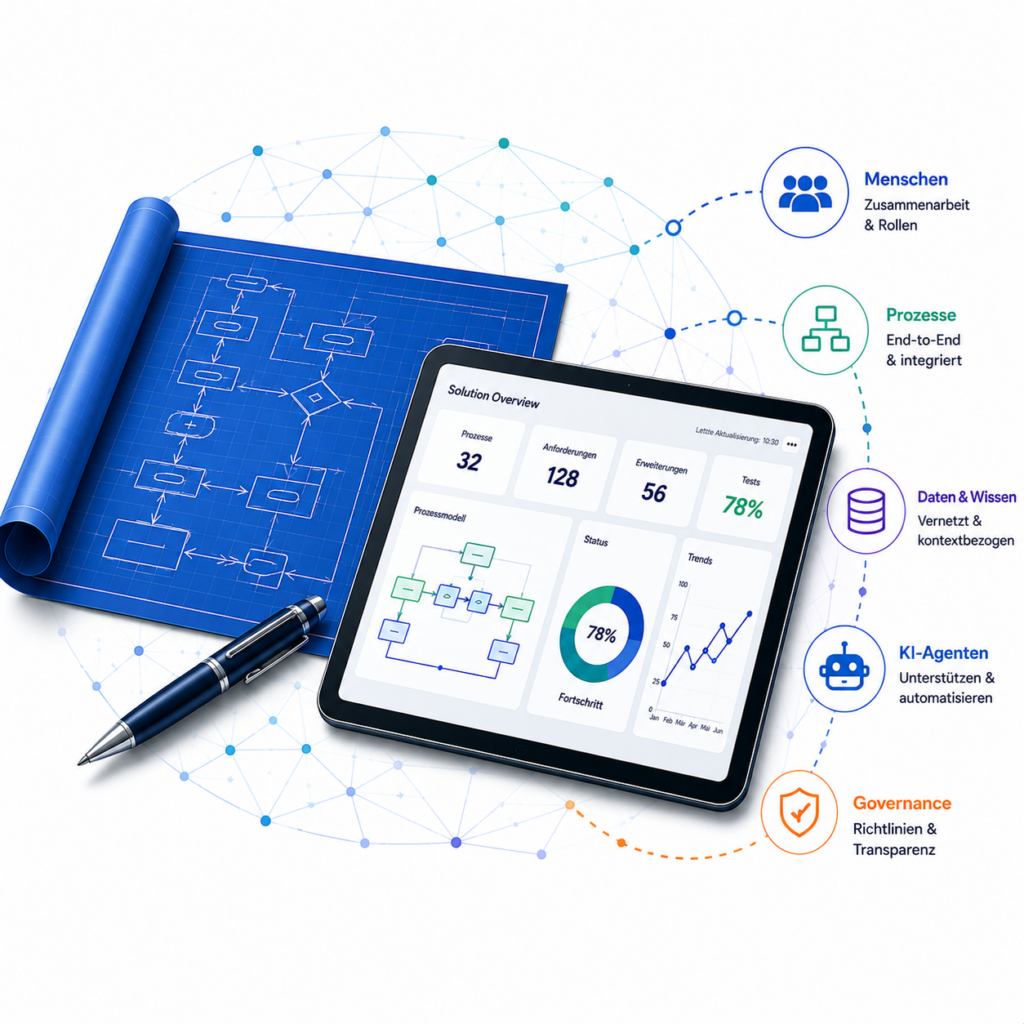
Methodology & Practice
From the classic SAP Business Blueprint to the Fit-to-Standard approach and on to Adaptive Solution Design for learning, AI-supported organizations.
For many years, the classic Business Blueprint was at the heart of SAP projects. Today, however, a static target concept is no longer enough. Organizations need iterative, standard-oriented and adaptive solution models.
For many years, the term Business Blueprint was inseparably linked to SAP projects. Anyone thinking of the classic SAP ASAP methodology automatically thought of the blueprint too: the functional and technical target design on which the system was later configured, extended and tested.
The blueprint was therefore far more than just a document. It was the common basis of understanding between business departments, IT, consulting, development and project management. At the same time, it was often very extensive, heavily document-centric and astonishingly detailed at an early stage of the project.
In the past, the future solution was described as completely as possible before it was implemented. Today it is validated early, designed iteratively and continuously developed further.
The era of the classic Business Blueprint
In the classic SAP ASAP methodology, the Business Blueprint was a central part of the definition phase. In workshops, the existing processes were recorded, the future workflows described and the requirements for the planned SAP solution documented in a structured way.
Typical contents of a Business Blueprint were:
Business processes
Process descriptions, variants, roles, responsibilities and organizational workflows.
Organizational structures
Plants, company codes, sales organizations, storage locations and other relevant structures.
Master data concepts
Materials, business partners, bills of material, routings, classifications and other core data.
Interfaces & integration
Connections to third-party systems, data flows, handovers and technical integration points.
Forms & reports
Outputs, analyses, printing concepts, labels, documents and legally relevant records.
WRICEF objects
Workflows, reports, interfaces, conversions, enhancements and forms.
The result was often a document running to several hundred pages. It served as the binding basis for customizing, development, test preparation and later acceptance.
Why the approach has changed
The world of projects has changed fundamentally. Cloud solutions, standardization, agile approaches, short innovation cycles and artificial intelligence call for a different kind of solution development. Organizations want to achieve usable results faster, stay closer to the standard and no longer work out requirements exclusively in documents over many months.
The central shift in perspective is therefore: it is no longer the complete description that comes first, but the early validation of a real solution.
From document to design process
What used to be understood primarily as a one-off project document is today a continuous design process. Processes, requirements, architecture, data, roles, enhancements and decisions are specified, reviewed and adjusted step by step.
Which terms are used today
The term blueprint has not disappeared entirely. It has, however, been supplemented or replaced by more modern and more context-specific terms.
| Term | Focus | Typical use |
|---|---|---|
| Solution Design | Holistic design of the solution | Architecture, processes, data, integration and implementation |
| Business Process Design | Design and optimization of business processes | Process management, transformation and standardization |
| Target Operating Model | Future operating and organizational model | Strategy, roles, governance, capabilities and value streams |
| Solution Blueprint | Architecture and solution framework | Still used occasionally in technology and architecture projects |
| Fit-to-Standard Design | Validation of the standard and targeted handling of deviations | SAP Activate projects and cloud transformations |
| Solution Documentation | Traceable documentation of the solution | Operations, audit, compliance, support and knowledge transfer |
From Blueprint to Fit-to-Standard
In the SAP Activate context, the classic Business Blueprint was replaced by a Fit-to-Standard approach. Instead of first describing a fully customer-specific target solution, the existing SAP standard is reviewed against concrete processes and scenarios.
- Validate SAP standard processes: Best practices and reference processes are reviewed in workshops.
- Identify gaps: Deviations between business requirements and the standard are made visible.
- Document requirements: Only relevant requirements are captured in a structured and traceable way.
- Define enhancements: Necessary WRICEF objects or other extensions are specified.
- Implement the solution design: Configuration, integration, development and testing take place iteratively.
The result is usually a leaner, more realistic solution that can be implemented faster. The standard forms the starting point. Individual extensions must be justified functionally and placed cleanly in architectural terms.
The TAOM perspective – thinking beyond SAP
TAOM goes well beyond classic SAP or ERP projects and views organizations as adaptive, networked and learning systems. Processes, knowledge, capabilities, decisions, governance, people and AI agents are designed not in isolation but as a coherent organizational system.
In this context, the term blueprint feels too static. It suggests that a target picture can be drawn once in full and then implemented unchanged. Adaptive organizations, however, work differently: they learn, respond to new information and continuously develop their capabilities.
Fitting terms in the TAOM context
Enterprise Process Design
End-to-end processes across functions and organizations.
Business Capability Design
Capabilities an organization needs for its value creation.
Target Process Model
Target picture of future processes, roles and responsibilities.
Operational Design
Operational interplay of people, systems and control.
Adaptive Solution Design
Learning, AI-supported and continuously improved solution models.
From a static document to a learning organizational model
The classic blueprint described what a solution should look like. Adaptive Solution Design describes how a solution is designed, reviewed, operated, learned from and further developed.
Business Blueprint and Adaptive Solution Design compared
| Business Blueprint | Adaptive Solution Design |
|---|---|
| Static target document | Living, continuously updated solution model |
| Document-centric | Model-, data- and knowledge-centric |
| High level of detail at project start | Detailing as needed at the right time |
| One-time definition | Iterative validation and continuous development |
| Changes are costly | Changes are part of the approach |
| Focus on system implementation | Focus on value creation, learning and adaptability |
| People describe and document | People and AI agents analyze, model, review and improve together |
Conclusion
The Business Blueprint was an important milestone in the development of professional SAP projects. It created structure, commitment and a shared understanding of the planned solution.
Modern transformations, however, call for a more flexible approach. With SAP Activate, Fit-to-Standard and modern design methods, the focus shifts: away from one-time completeness and towards early validation and continuous improvement.
For adaptive and AI-native organizations, this development goes one step further. Solutions are not only planned and implemented. They are observed, evaluated, learned from, adjusted and continuously optimized.
Blueprint was yesterday. Adaptive Solution Design is the future.

TAOM.ai – The Adaptive AI Organization Method™
TAOM connects processes, knowledge, decisions, governance, digital twins and AI agents into an adaptive organizational and operating model. This creates solutions that not only work today but also keep evolving tomorrow.
Leave a Reply