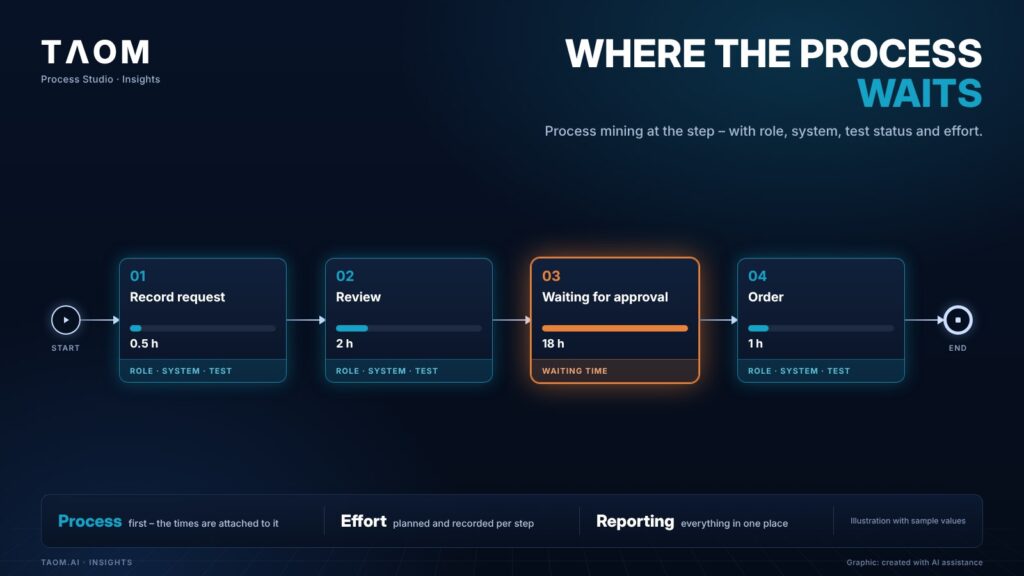
Many only notice at month-end closing where time is lost in the process. Process mining promises a remedy – and yet is often a project of its own alongside the actual process.
Two directions
Process mining uses the event data of systems to show how processes actually run. The basics are described in the Process Mining Manifesto of the IEEE Task Force. Classically, you start with the data and look for the process in it.
TAOM takes the opposite route: it starts with the process and attaches the times to it. That makes it immediately clear which step, which role and which system are behind a waiting time.
| Classic | In TAOM | |
|---|---|---|
| Starting point | Event data | Process model |
| Result | discovered process | waiting time at a known step |
| Role and system | assigned afterwards | already at the step |
Which times are recorded at the step
For each step, processing, waiting and idle time, lead time, set-up and transport can be recorded – with unit and period. Instead of single values there are key figures: mean, median, minimum, maximum, 90th percentile and number of cases per day, week, month or year. Every figure states where it comes from: entered manually or via an interface.
The mapping to a system’s event log is prepared via activity and object type. We provide automatic transfer, for example from an ERP system, on request and tailored to your systems.
What does implementation cost – per step?
For every initiative, you can plan and record at the step what implementation requires. That way you see not only that a project is over plan, but where.
Everything in the same place
Times, project effort, test relevance, test cases and risks sit at the same step. Everything comes together in reporting. Anyone who finds a slow step immediately sees whether it is tested and what its implementation cost.
Process mining is an add-on licence with its own term. Project times are included from Process Studio Modeller upwards. Evaluation across all models in an area comes with the Reporting add-on licence.
In short
Times and effort belong at the process step. Then a waiting time is not a number in a dashboard but a step with role, system, test status and costs.
About TAOM: TAOM is the method and platform of Traniva AG (Switzerland) for people, processes and AI working together – with Process Studio Editor and Viewer, TAOM Training and Support. Our principle: AI supports, responsibility stays with people.
Read more: Process mining and project times · Reporting · Learning video: Process mining · Process Mining Manifesto (PDF)
Leave a Reply