Anyone talking about AI in companies today hears, alongside the enthusiasm, one question above all: what happens to my work? It deserves an honest answer, not reassurance.
What the studies say
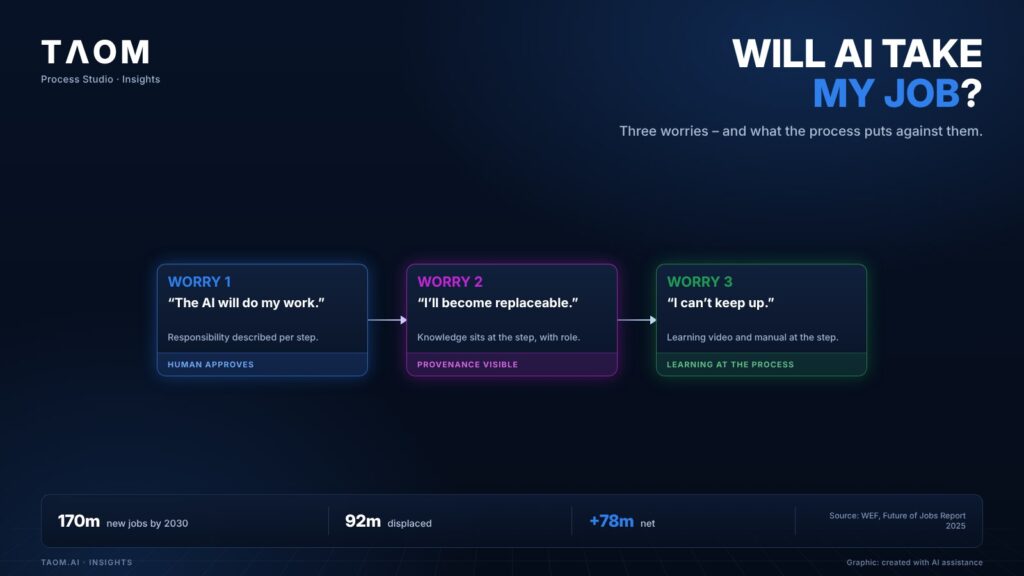
In its Future of Jobs Report 2025, the World Economic Forum expects 170 million new and 92 million displaced jobs worldwide by 2030 – a net gain of 78 million. At the same time, almost 40 per cent of the skills needed on the job will change. Of every 100 workers, 59 will need training.
In its analysis of generative AI, the International Labour Organization concludes that the technology is more likely to complement work than to replace it. Clerical work is the most exposed.
Taken together: the job does not disappear, but many tasks within it change. The people who do them today need to be able to keep up.
Three fears – and what helps
| The worry | What is behind it | What TAOM puts against it |
|---|---|---|
| “The AI will do my work.” | It is unclear what the agent does and what the human does. | Every agent has a described responsibility. What it produces is labelled as an AI result. A human approves. |
| “My knowledge gets extracted and I become replaceable.” | Knowledge ends up in chat histories, detached from the people who hold it. | Knowledge is attached to the process step, with role and responsible people. Who contributed it stays visible. |
| “I can’t keep up any more.” | Training happens separately from the work. | Learning videos and the manual sit at the step, in the Viewer and in TAOM Training. |
AI in the process rather than next to it
Most worries arise when AI is introduced as a tool alongside the actual work: every department its own assistant, results without provenance. Then nobody knows any more what applies.
If, on the other hand, AI works within the described process, it is clear for every step who is responsible, what the agent contributes and where the human decides. That does not take work away – it makes visible which work counts.
If you know where you stand in the process, you need not fear an agent in the process.
What companies can do in practice
- Involve the people who know the process. They know where things get stuck today – and they are the first to notice when an agent gets something wrong.
- Describe the process first, then automate. Record for each step who is responsible and what the agent may contribute.
- Keep approvals where the responsibility lies. Anything that goes outside or has consequences is approved by a human.
- Bring learning into the work. Short explanations right at the step instead of training days far removed from everyday work.
In short
The figures point to change rather than loss – but only those who keep up will benefit. That is why responsibility, approval and learning belong where the work happens: at the process step.
About TAOM: TAOM is the method and platform of Traniva AG (Switzerland) for people, processes and AI working together – with Process Studio Editor and Viewer, TAOM Training and Support. Our principle: AI supports, responsibility stays with people.
Read more: TAOM AI workforce · What may an AI agent decide? · WEF Future of Jobs 2025 · ILO Working Paper 96
Leave a Reply