Solutions
Business knowledge becomes an organisation you can actually steer.
In most organisations, processes, requirements, systems, knowledge and AI sit in separate tools. TAOM connects them in one shared context – from the first workshop to continuous improvement.
Five solutions
Five ways in – one shared context
Each solution answers a task of its own. Because they all work on the same enterprise context, every task also grows the bigger picture.
01
SAP transformation
From the SAP standard through the customer process to the gap, the requirement and the development object – without losing the business rationale.
View →
02
Process discovery
Conversations, workshops and documents become a structured BPMN model that specialists then review and enrich.
View →
03
Requirements management
Every requirement stays connected to the process step, the role and the system it came from.
View →
04
AI workforce
AI agents as governed digital roles in the operating model – with accountability, knowledge access and clear limits instead of scattered copilots.
View →
05
Governance & compliance
Traceable: who created, reviewed and approved what – and which version applies right now.
View →And behind it
Digital Twin
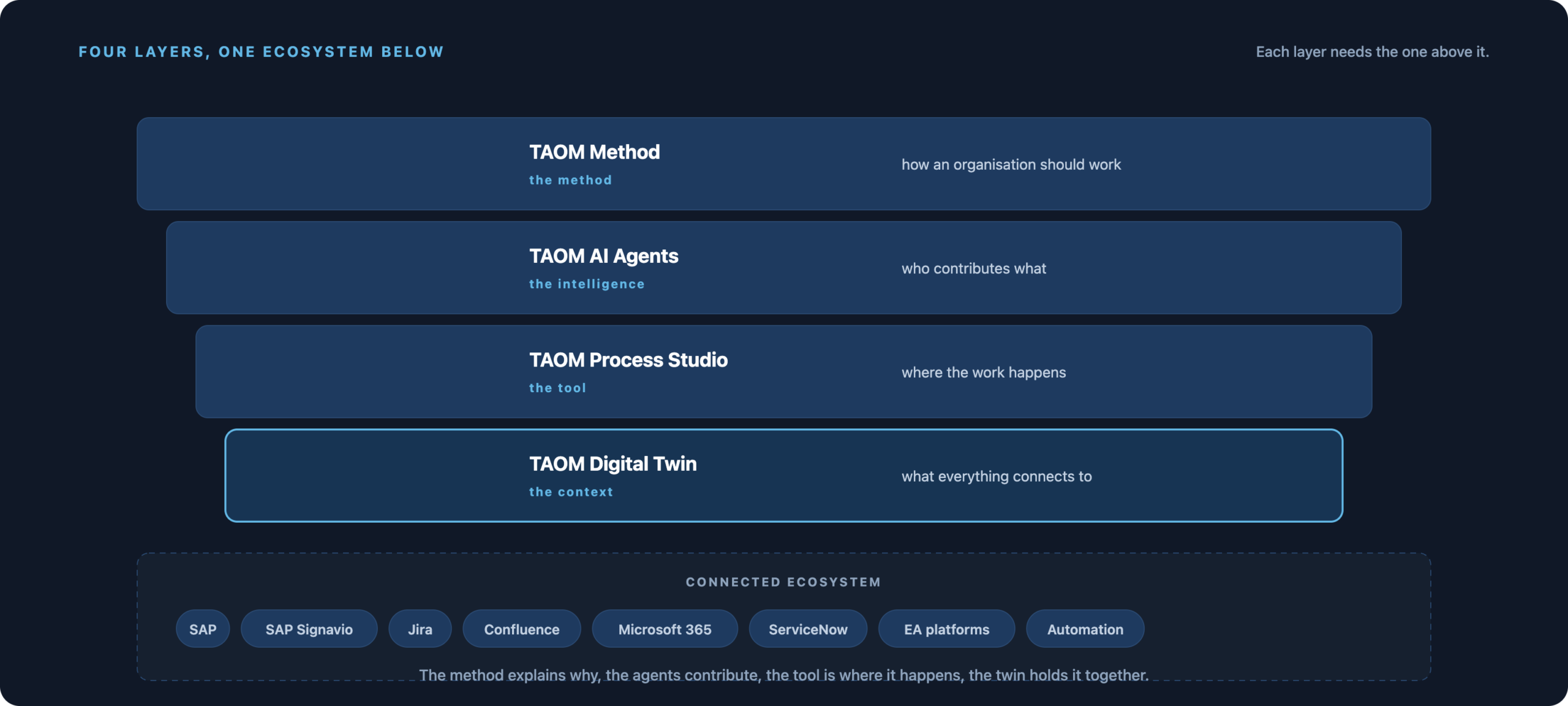
The Digital Twin is not a sixth solution but what emerges from all five: the shared data layer. Likewise, Process Studio is not a solution but the tool that makes several of them possible.
The common thread
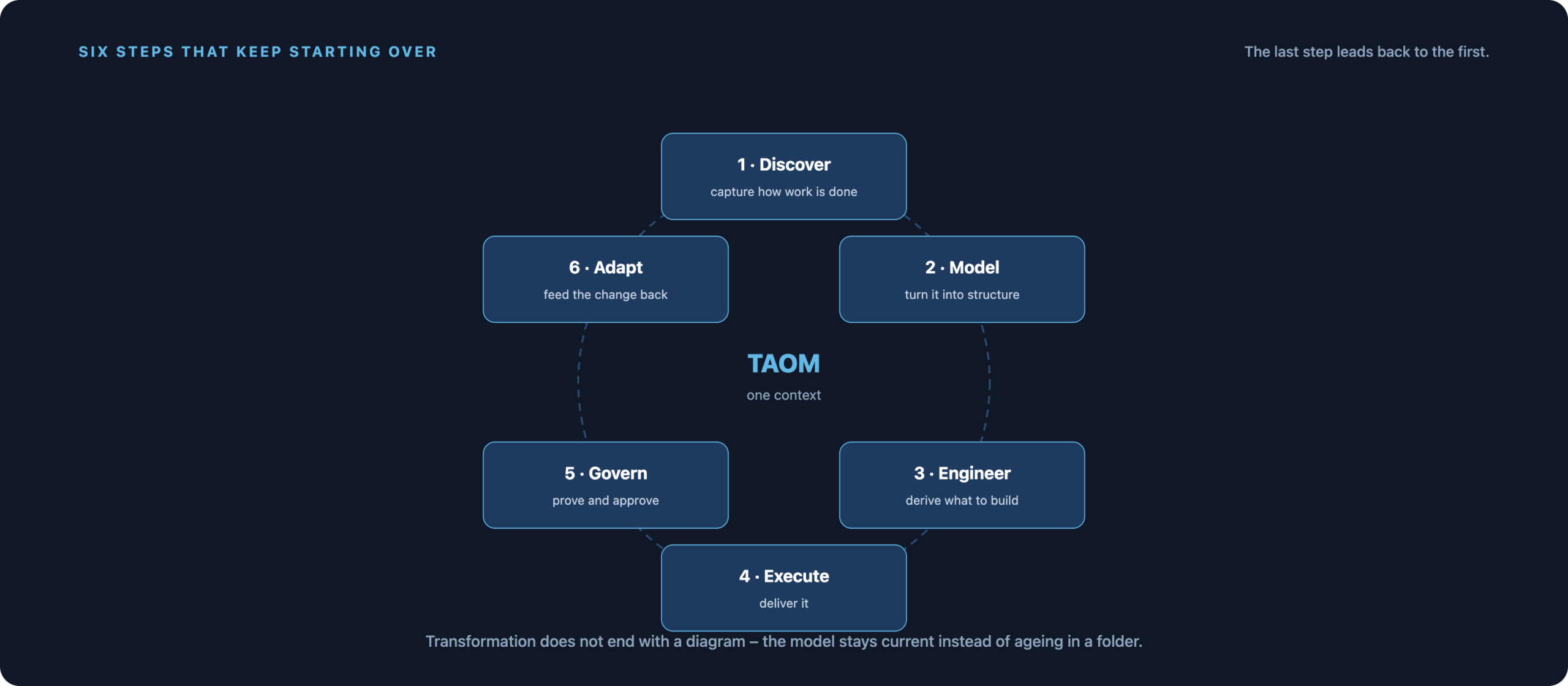
Six steps that keep starting over
Transformation does not end with a diagram. The last step leads back to the first – which is why the model stays current instead of ageing in a folder.
The connection
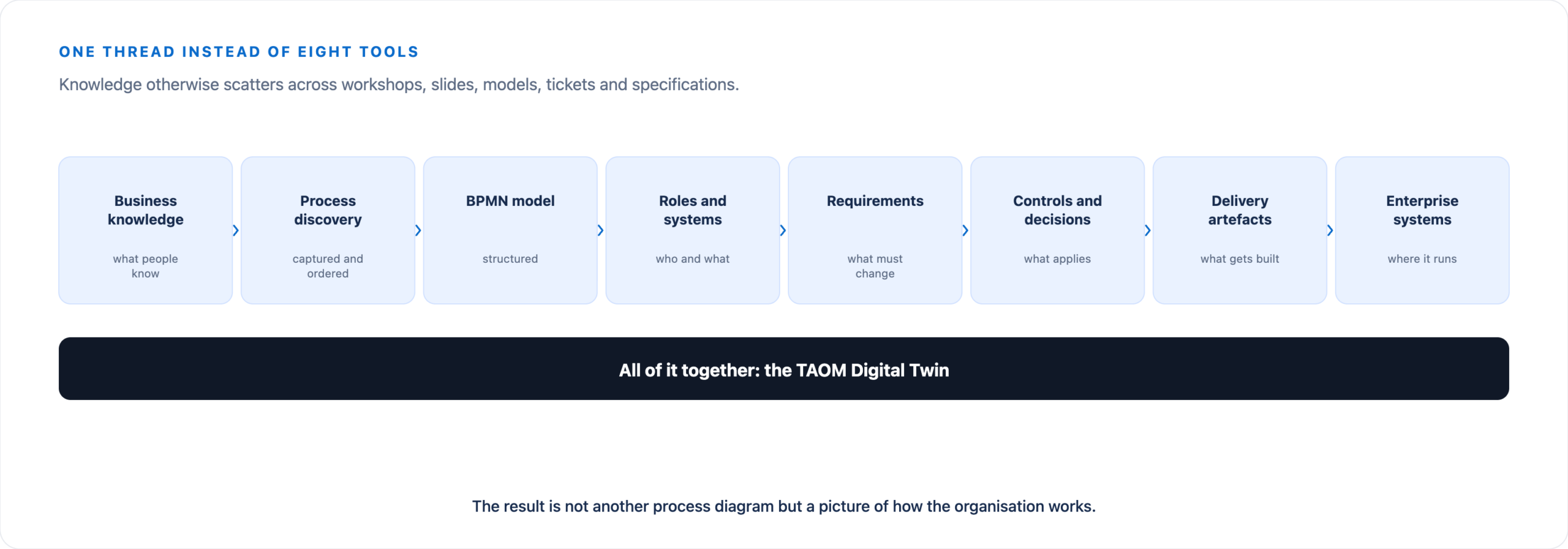
One thread instead of eight tools
Transformation starts with people explaining how their organisation works. Otherwise that knowledge scatters across workshops, slides, models, tickets and specifications.
01 · SAP transformation
From standard to development object – in one context
An SAP project is not finished with documented processes. The standard has to be held against business requirements, gaps have to be named, and delivery objects derived from them. TAOM keeps these steps together.
- SAP Best Practice
- Customer process
- Fit / Gap
- Requirement
- WRICEF
- Functional specification
- Technical specification
- Jira
- Test
- Documentation
Typical use cases
- S/4HANA transformations
- Global template programmes
- Fit-to-Standard-Workshops
- SAP best practice comparison
- WRICEF identification
- Requirements management
- Jira connection
- SAP Signavio connection
- Process documentation
- Testing and validation
02 · Process discovery
Spoken words become a model
Process knowledge lives in people’s heads. In workshops and interviews, staff describe what they actually do, where decisions are made, which systems are involved and where things get stuck. The TAOM agents read this everyday language and turn it into structured process information.
- Conversation, workshop, document
- AI analysis
- Activities
- Roles
- Decisions
- Systems
- Business rules
- BPMN 2.0
In Process Studio, people then review, complete and take responsibility for the result. Approval stays with people.
Typical use cases
- Discovery workshops
- Brownfield analysis
- Process documentation
- Subject-matter interviews
- As-is capture
- To-be process design
- BPMN generation
- Standardisation
03 · Requirements management
The requirement stays with its process
Requirements often lose their origin as a project runs. TAOM keeps the link between a requirement and the process step, role, system or goal it came from. That turns a process into the starting point for delivery.
- Process step
- Business requirement
- Functional requirement
- System context
- WRICEF
- Functional specification
- Technical specification
- Delivery object
Typical use cases
- Business requirements
- Functional requirements
- Technical requirements
- WRICEF identification
- Functional specifications
- Technical specifications
- User Stories
- Acceptance criteria
- Jira connection
- Traceability
04 · AI workforce
AI agents as roles, not scattered helpers
AI should not sit beside the organisation as a collection of individual copilots. In TAOM, agents are part of the operating model: with accountability, capabilities, knowledge access and limits. People and agents appear in the same model.
- Discovery agent
- Modelling agent
- Requirements agent
- Enterprise / SAP agent
- Knowledge agent
- Governance agent
- Delivery agent
How the agents work together in the tool is described in the user guide.
Typical use cases
- AI-assisted process engineering
- Enterprise AI agents
- Human–AI collaboration
- Accountability for agents
- AI governance
- Knowledge-driven agents
- Process-aware AI
- Multi-agent orchestration
05 · Governance & compliance
Traceable: who is accountable for what
Enterprise AI needs more than generation. What was produced, what it rests on, who reviewed it and which version applies must all be traceable. TAOM combines AI support with human accountability.
- AI generation
- Provenance
- Human review
- Validation
- Approval
- Versioning
- Reviewed artefact
This information sits in the process and in the Digital Twin, not in separate documentation. More under Compliance & Governance.
Typical use cases
- Human-in-the-Loop
- Transparency about AI contribution
- Process governance
- Approval workflows
- Version management
- Controls
- Auditability
- Provenance record
- Compliance documentation
- Transparency under the EU AI Act
The structure
One platform, several perspectives
A process captured in a workshop becomes a BPMN model. The model produces requirements, those produce delivery objects, and those produce entries in the target systems. Agents support every stage, and the evidence stays attached to the result. Together that is the Digital Twin.
Where this fits
Where this page sits
Method describes the thinking, Product the tools, Solutions the tasks you use them for.
Start with one process
You do not have to change the whole organisation at once. Describe one workflow, have it structured, review the result – and extend the model step by step.
- Describe a workflow
- Review the model
- Add roles and systems
- Derive requirements
- Extend step by step