People know how the process works. It just has never been documented properly.
Process knowledge lives in people’s heads, meetings, emails, and years of experience. Talk through the process – TAOM builds the model around it.
Everyday language is enough
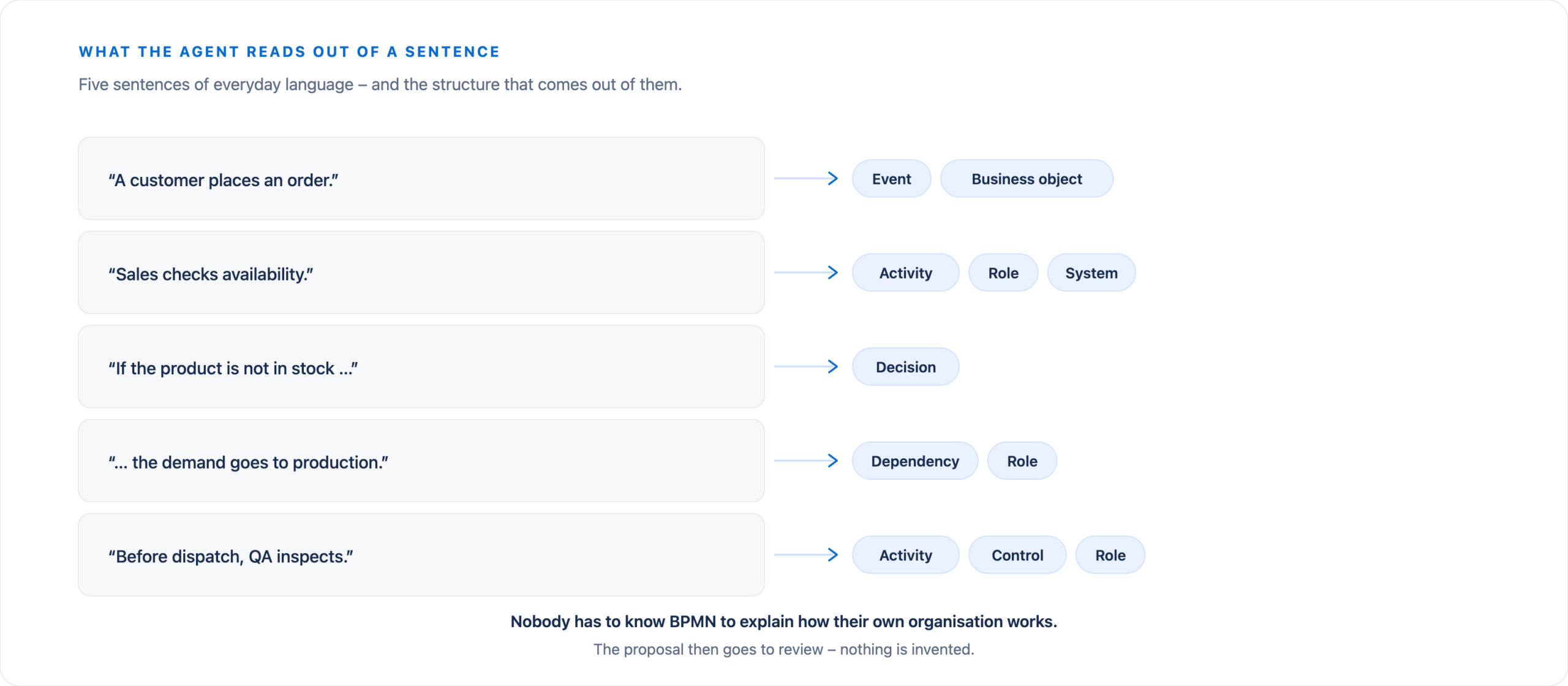
Nobody needs to speak BPMN to explain how their work gets done.
“A customer places an order. Sales checks availability. If the product is not in stock, demand is passed to production. Before shipment, Quality Assurance inspects the finished product.”
Where the knowledge comes from
Eight sources, one model
Process knowledge rarely exists in one place. Discovery can start with whatever already exists.
- Workshop conversations
- Interviews
- Process descriptions
- Work instructions
- Existing BPMN models
- Business requirements
- Project documentation
- Operational experience
Spoken language as well
The agent does not only process written text. A recorded conversation or a dictated process flow can be handled in exactly the same way – significantly lowering the barrier in workshops.
Anyone who can explain how they work can have the process modeled.
Existing models as a starting point
If a BPMN model already exists, it is loaded as the original and remains unchanged. Discovery then enriches the existing model instead of redrawing it from scratch.
What already exists is preserved – learn more.
More than sequence
Seven questions that good Process Discovery should ask
“What happens next?” is the simplest – and usually the least valuable – question. The real insight comes from what surrounds the sequence.
- 01Who performs the activity?
- 02Which system is used?
- 03Which decision is made here?
- 04What information is required?
- 05Where do recurring issues occur?
- 06Which controls apply?
- 07Which requirement follows from this?
As-Is and To-Be
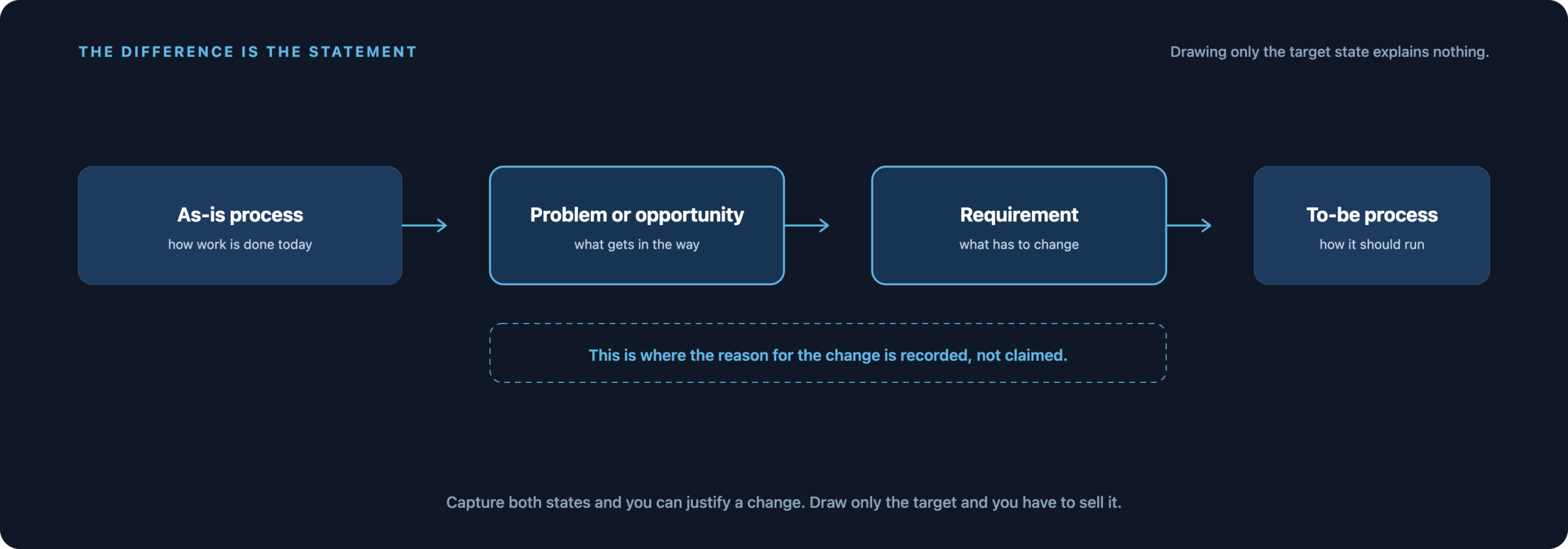
Modeling only the target state explains very little.
Discovery captures both sides: how work is performed today and how it should work in the future. Only the gap between the two provides a clear rationale for change.
Ask instead of assume
AI that invents business logic is dangerous.
What the agent asks when information is missing
- ?Who approves this step?
- ?What happens if the validation fails?
- ?Which system creates the document?
- ?Is this step manual or automated?
Why this improves quality
An open question is an honest outcome. An invented answer may look better, but it can cost days later because nobody realizes the underlying assumption was wrong.
Questions and answers remain traceable in the history – the grace period determines how long the agent waits for a response.
What Process Discovery also reveals
Discovery identifies more than process steps.
If you listen carefully, every workshop produces findings that are, in reality, requirements.
Missing capabilities
What the system cannot do and what users therefore work around.
Workarounds
The spreadsheet beside the system that operations cannot function without.
Integration gaps
Data that has to be transferred manually.
Compliance obligations
Evidence and controls that someone fulfills on the side.
Data quality issues
Fields that nobody trusts.
Organizational issues
Responsibilities that are not documented anywhere.
Typical use cases
Where Process Discovery is used
- 01Discovery workshopsCapture knowledge in the room while everyone is together.
- 02Business interviewsOne-to-one conversations in which people explain how the work actually happens.
- 03As-Is assessmentDocument how work is really performed today.
- 04To-Be Process DesignDesign the target state with a clear rationale, not just a diagram.
- 05Brownfield analysisUnderstand established environments before changing them.
- 06Process harmonizationMake process variants visible before consolidating them.
- 07Mergers and organizational redesignCompare two ways of working side by side.
- 08Knowledge retentionCapture experience before it leaves the organization with a person.
Getting started
Start with what people already talk about
You do not need a finished process document. A conversation, workshop, description, or existing model is enough to begin.