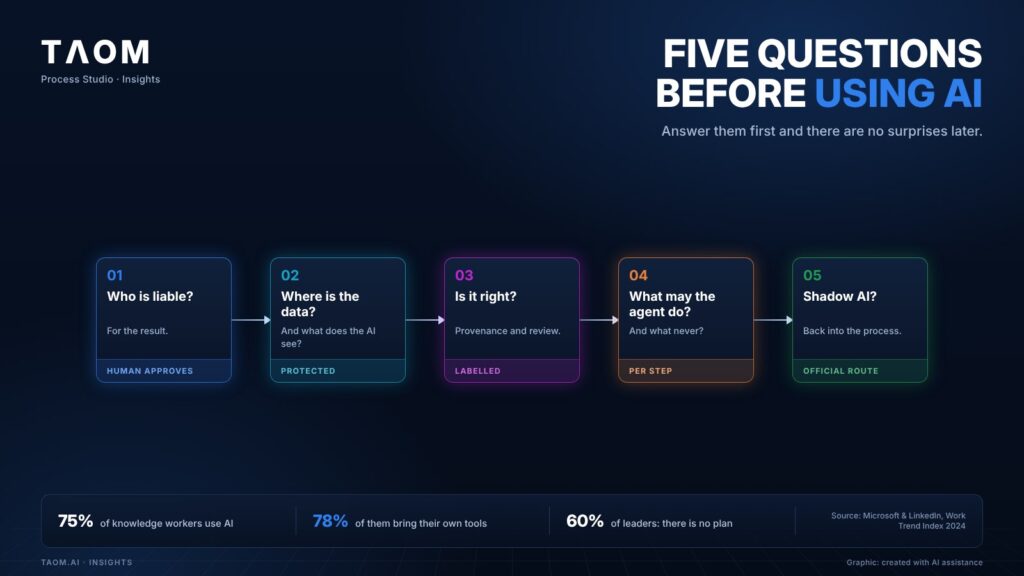
According to Microsoft and LinkedIn’s Work Trend Index 2024, three out of four knowledge workers use AI at work – and 78 per cent of them bring their own tools. 60 per cent of leaders worry that their company lacks a plan for it. So the question is no longer whether AI is used, but whether it is used in an orderly way.
1. Who is liable for the result?
The answer has to be settled before deployment, not after the first mistake. The EU AI Act requires effective human oversight for high-risk systems (Art. 14). TAOM implements this as a matter of principle: an agent proposes, a human approves, and the approval is recorded on the result with person and time.
The regulation applies in the EU. It concerns Swiss companies mainly when they offer AI systems in the EU or when their output is used there.
2. Where is the data – and what does the AI see of it?
The Swiss Federal Data Protection and Information Commissioner states that the Data Protection Act applies directly to AI-supported processing; purpose, functioning and data sources must be transparent (FDPIC: AI and data protection). With TAOM, the default case starts in Switzerland (Trust Center), and personal or confidential content is detected and protected before it reaches an AI (Automated data protection).
3. How do I know it is correct?
A result without provenance is a claim. In TAOM, it is labelled what an agent produced and what a human has checked. Versions and approvals are logged – traceable rather than asserted after the fact.
4. What may the agent do – and what never?
Autonomy is not a property of the agent but of the step. How to define it in three levels is described in our post What may an AI agent decide?.
5. How do we bring shadow AI back?
Shadow AI refers to AI tools that employees use on their own initiative – without approval, without a contract and often with company data. Bans rarely work. A better approach is a way that is easier than the private chat: an agent that knows the company because it works on the process model, and whose results end up where everyone can find them.
Checklist
☐ Responsibility defined for each step · ☐ Data location and data flow known · ☐ AI results labelled · ☐ Authority described for each step · ☐ An official route that is better than the private one
To go deeper: the NIST AI Risk Management Framework – a freely available framework for identifying and managing AI risks.
About TAOM: TAOM is the method and platform of Traniva AG (Switzerland) for people, processes and AI working together – with Process Studio Editor and Viewer, TAOM Training and Support. Our principle: AI supports, responsibility stays with people.
Read more: Governance and compliance · AI workforce · Trust Center
Leave a Reply