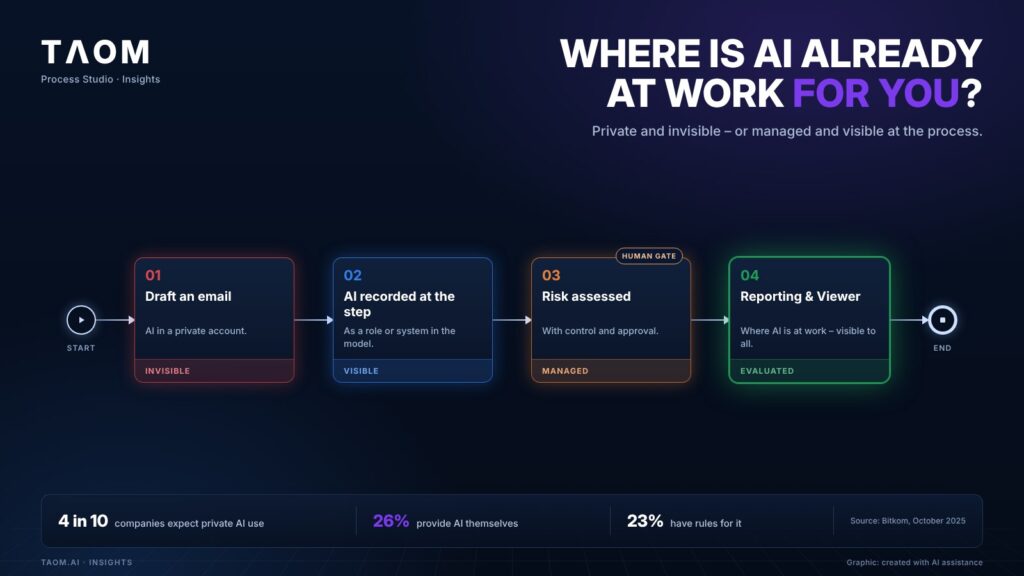
Who hasn’t had an AI draft or answer an email? The question is no longer whether AI is used in your company. It is: do you know where, how and why – and does your process model show it?
AI is already in the process – often with a private account
According to a representative Bitkom survey from October 2025, 4 out of 10 companies in Germany assume – or know – that employees use private AI tools for work. Only a quarter provide access to generative AI themselves, and just under a quarter have rules for it. Microsoft and LinkedIn’s Work Trend Index 2024 shows the same picture internationally: 78 per cent of AI users bring their own tools.
This is rarely bad intent. Drafting a reply, summarising a long document, having a formula explained – it saves time. But it happens in a private chat: with company data, without approval and without a trace in the process.
Put up with it or steer it?
| Here and there, privately | Introduced centrally, at the process | |
|---|---|---|
| Who knows about it? | The person themselves – maybe the team | Everyone who knows the process |
| Which data? | Whatever gets pasted into the chat | What the classification allows |
| Who checks the result? | Nobody explicitly | A defined role approves |
| When something goes wrong | Nobody knows where it came from | Provenance and approval are on the result |
| Evidence | None | In the model, in reporting, in the Viewer |
The bigger danger is not that employees use AI. It is that nobody knows where – and nobody is responsible.
Bans rarely help; the tools are on every smartphone. What works better is an official route that is easier than the private one – and a process model that shows where AI is at work. The questions to settle beforehand are in our post Five questions before using AI.
Not just corporations – small businesses and authorities too
In a small business, one person answers customer enquiries with AI – including names, addresses and prices. In a corporation, a hundred teams work with a hundred different assistants. And in public administration, official secrecy and data protection come on top: much data may not go into public AI applications at all for information security reasons. The Swiss federal administration has therefore piloted its own AI application in an isolated environment (Netzwoche: Bund testet Gov-GPT).
Size changes the tool, not the question: where does AI work, with which data – and who is accountable for the result?
Can your process modelling show this today?
Questions for your process model
☐ Can you see at the step whether AI is involved? · ☐ Which AI, with which data? · ☐ Who approves the result? · ☐ Is the risk assessed, is there a control? · ☐ Can you ask across all processes: where is AI used?
In most tools, the honest answer is no. The model is a picture – and what is not in the picture does not exist for the organisation.
How AI becomes visible in the process – in TAOM
Assess with and without risk
Not every use of AI is equally critical. An email draft that a person reads and adapts is different from an automatic reply to customers that nobody looks at any more. In TAOM, severity, probability and detectability give the risk class at the step – and from it controls and test depth. If a process is to run with AI in future, Change Impact assesses the new variant against the valid version before it applies.
With us, AI works within the process – not next to it
We don’t use AI in bits and pieces; we build it into the processes – right down to process modelling itself. The TAOM Agent turns a description into a model, asks about gaps and only builds after approval. Further agents work out the steps: application context, requirements, risks and tests. Every contribution is labelled, every approval has a name. So the model shows not only where your employees use AI – but also where TAOM itself does.
Questions? We’ll work through it with you
Not sure where AI is already at work in your organisation today? That is the normal case. Together we go through your processes: where is AI in use, privately or in a managed way? Which data flows, which risks arise, which controls are missing? We record the result in the process model, keep it up to date and make it visible with evaluations in the Editor – for management as well as for the team that works with it every day.
Get in touch – whether small business, corporation or administration.
In short
AI has long been part of everyday work – often invisible and private. Recording, assessing and approving it at the process step turns shadow AI into managed use. TAOM shows this in the model, in reporting and in the Viewer.
About TAOM: TAOM is the method and platform of Traniva AG (Switzerland) for people, processes and AI working together – with Process Studio Editor and Viewer, TAOM Training and Support. Our principle: AI supports, responsibility stays with people.
Read more: Five questions before using AI · What may an AI agent decide? · TAOM AI workforce · Information protection and classification · Bitkom: employees use shadow AI (German)
Leave a Reply