TAOM™ Glossary
Same words, different meanings – that can cost projects months.
Business, Architecture, Delivery, AI, and Governance use many of the same terms while rarely meaning exactly the same thing. The Glossary defines them once – and shows how they connect.
More than a dictionary
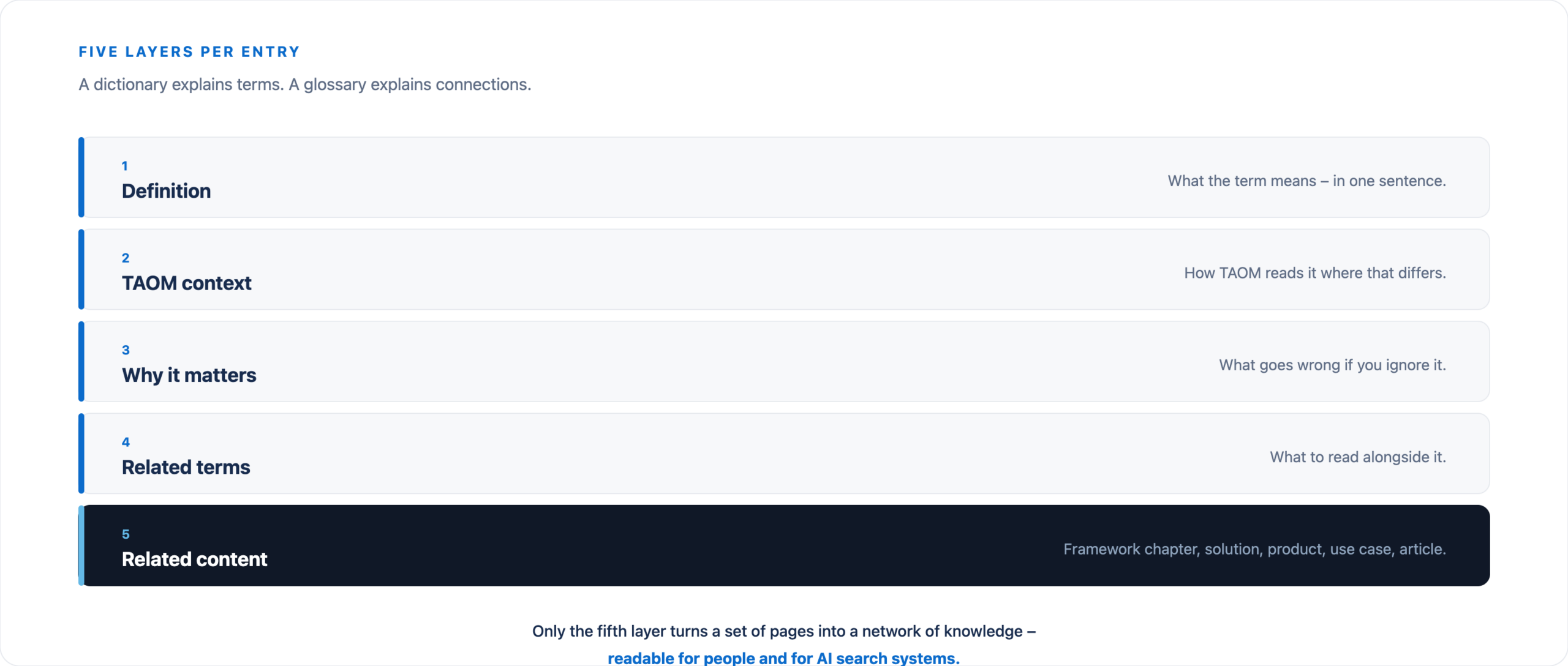
Five layers per entry
A definition alone is of limited value if it remains unclear where the term appears in actual work.
By Domain
Seven domains, 38 terms
Organization
Adaptive Organization · Operating Model · Capability · AI-Native Organization
Process
BPMN · Original and Generated · Process Discovery · Process Hierarchy L0–L5 · Process Phase · RACI Matrix
AI
Agent Skill Profile · Agent Level · Human in the Loop · Grace Period · AI Agent · AI Workforce · AI Provenance · Quality Seal
Context and Digital Twin
Shape · Verification duty · Test case · Traceability matrix · Reference · Governed references · State · Presence · Workspace · Enterprise Digital Twin · Tenant Isolation · Process Digital Twin · Enterprise Context
Engineering
Requirement · Solution Design · Functional Specification · Fit and Gap · Integration Levels · Reference Repository · Technical Specification · WRICEF
Governance
Framework
A to Z
All Terms
Click to expand. Each entry includes the definition, TAOM Context, and the pages where the term is used in practice.
Enterprise process modelProcess
The functional structure of all processes in a company – from the process landscape down to the single flow.
In the TAOM context: The enterprise model belongs to the tenant, not to a project: several initiatives work on the same structure, so that P2M means the same in the logistics project as in HR. Every step identifier is derived from it.
Related: Enterprise process model · In 60 seconds · Seven views
Procedure (L5)Process
The lowest level of the enterprise process model: the process flow itself.
In the TAOM context: The BPMN model sits on L5. There is no level below – what follows are objects of the digital twin: activities, roles, systems, requirements, controls.
Related: Enterprise process model
End-to-end processProcess
A value stream that runs from start to finish – P2M, O2C, S2P, I2D, R2R.
In the TAOM context: On level L2 of the enterprise model. An end-to-end process often corresponds to a stream of the project organisation; the link is maintained, not duplicated.
Related: Enterprise process model · Project organisation
Process identifierProcess
The unique identifier of a process step, derived from the model number – for example P2M.02.01-AC001.
In the TAOM context: The same identifier appears in the model, in the BPMN file, in the Jira issue and on the Confluence page. If a process is moved, page and issue move with it; the former identifier stays on the element.
Related: Enterprise process model · In 60 seconds
Structure pageProcess
A Confluence page that represents one level of the enterprise model and lists the pages below it.
In the TAOM context: It is created during transfer and refreshed on every run. Additions belong on the page of the individual process, not on the drawer.
Related: Enterprise process model
Return pathGovernance
The way a change travels from Confluence or Jira back into the model.
In the TAOM context: Whatever is entered in a human zone is reported back to the model by the TAOM app. The footer of each page carries tenant, project, node, number and workspace – that is how a report finds its origin, even after the page was renamed.
Related: In 60 seconds · Project organisation
Adaptive OrganizationOrganization
An organization that continuously learns from changes in its environment and adapts its processes, structures, capabilities, and technology accordingly.
In the TAOM Context: Adaptation is not an occasional project, but a permanent capability: Learn → Decide → Change → Execute → Observe → Adapt.
Related Content: Theory · THY-13
Agent Skill ProfileAI
The definition of what an Agent is able to do, what it needs to know, and what it is permitted to do.
In the TAOM Context: Assigned by role in the Admin Panel rather than negotiated individually for each person.
Related Content: Skill Profiles
RequirementEngineering
A documented need that a process, system, or solution must fulfill.
In the TAOM Context: A Requirement remains connected to the Process Step, Role, and System from which it originated.
Related Content: Solution · Engineering
PresenceContext and Digital Twin
The indication of who is currently working in the same Workspace and what they are working on.
In the TAOM Context: Deliberately designed as Stage One of Collaboration: activity is reported and displayed only – nothing is locked and nothing is changed.
Related Content: Collaboration
WorkspaceContext and Digital Twin
The defined space in which an initiative and its models and related information are managed.
In the TAOM Context: Workspaces carry an identifier through which provenance and tenant context can later be resolved.
Related Content: Collaboration
Operating ModelOrganization
The complete set of mechanisms through which an organization creates value and governs itself.
In the TAOM Context: In TAOM, these are the 21 mechanisms of the Operating System – from a shared language through to feedback.
Related Content: Operating System · OS
Solution DesignEngineering
The structured handover of process and requirement information to Jira and Confluence. Under SAP Activate and in PMI usage this step is called Solution Design; it was formerly also called Blueprint.
In the TAOM Context: The model produces an epic, stories per phase, issues per step and a page tree of specifications – after human approval and reconciled on every run instead of creating duplicates.
Related Content: Integrations
Verification dutyContext and Digital Twin
The detail on the process step stating whether it must be verified – with three values: yes, no, open.
In the TAOM context: Deliberately a detail of its own rather than derived from compliance: not every step with a standard reference must be verified, and not every step that must be verified carries one. The value open matters most – it separates “examined and found not to require verification” from “nobody has looked yet”.
Related: Digital Twin · Prices and packages
Test caseContext and Digital Twin
The description of a check: precondition, steps, expected result, evidence – linked to requirement, control and risk.
In the TAOM context: The test case is born on the process step and carries its identifier. What becomes of it in the test tool is a question of connection – the case itself is described in business terms and stays independent of the tool.
Related: Digital Twin · Integrations
Traceability matrixContext and Digital Twin
The mapping of requirement to test case to result, across all steps.
In the TAOM context: It is not maintained but derived: the references sit on the process steps, the matrix falls out of them. Empty cells are not a fault of the table – they show where something is missing that the house’s own verification duty says should be there.
Related: Digital Twin · Governance
ShapeContext and Digital Twin
An element of the process model together with its structured details – not merely a form on the canvas.
In the TAOM context: The shape carries sequence, role, system, requirement and identifier. It is where the connection lives, and therefore the basis for everything derived from it.
Related: Digital Twin · Process Studio
ReferenceContext and Digital Twin
The lasting link between a shape and an object in a target system, held through the TAOM identifier.
In the TAOM context: A reference comes into being when the object is created, not when it is read back. Only for that reason does anyone later know which process step a Jira issue or a Confluence page belongs to.
Related: Integrations · Digital Twin
Governed referencesContext and Digital Twin
References that are not merely present but tended: created, updated, read back.
In the TAOM context: The tending is what makes the difference. A link created once ages; a governed link stays valid because someone is accountable for it – the agent.
Related: Digital Twin · AI workforce
StateContext and Digital Twin
What comes back from the target systems to the shape: done, approved, progress, version.
In the TAOM context: The state lives on the process step, not only in the target system. Only then does a model answer which part of the process is implemented – and stops being a picture.
Related: Digital Twin · Integrations
BPMNProcess
Business Process Model and Notation – a standardized graphical language for business processes.
In the TAOM Context: TAOM uses BPMN as an important representation, but does not treat the diagram as the entire enterprise model. Roles, Systems, Requirements, Knowledge, Controls, and Agents can all be connected to an Activity.
Related Content: Product · BPMN demos
ComplianceGovernance
Compliance with external regulations, internal policies, standards, and defined requirements.
In the TAOM Context: TAOM connects Compliance Requirements directly to the objects they affect.
Related Content: Compliance & Governance
Agent LevelAI
The scope an Agent operates on: Diagram, Shape, Phase, Process, or User and Role.
In the TAOM Context: The level determines what an Agent is able to see and change – and is one reason why TAOM uses seven specialized Agents rather than a single general-purpose Agent.
Related Content: AI Agents
Enterprise Digital TwinContext and Digital Twin
The connected representation of the entire organization across Processes, Capabilities, Roles, Systems, Requirements, Knowledge, Controls, and AI.
In the TAOM Context: It evolves incrementally. Not everything needs to be modeled before value can be created.
Related Content: Digital Twin
Functional SpecificationEngineering
The description of what a solution must deliver from a business perspective.
In the TAOM Context: It remains connected to the Requirement, Process Step, System Context, and Development Object.
Related Content: Engineering
CapabilityOrganization
Something an organization must be able to do in order to achieve an outcome.
In the TAOM Context: Capabilities form the bridge between Strategy and Execution: Business Objective → Capability → Process → Application → Requirement.
Related Content: Architecture
Fit and GapEngineering
The assessment of whether a standard process fits the business need or not.
In the TAOM Context: A Gap is not a defect. It is a statement about the business – provided the reason behind it remains traceable.
Related Content: SAP Transformation
GovernanceGovernance
The structures, responsibilities, rules, and controls through which activities are directed and overseen.
In the TAOM Context: Controls are connected directly to Processes, Requirements, Systems, Decisions, Agents, and Artifacts – not stored separately in a folder.
Related Content: Compliance & Governance · MGT-09 · Where nobody is responsible
Human in the LoopAI
A governance principle in which humans retain defined responsibility for review, approval, and oversight.
In the TAOM Context: This does not mean every AI action requires human approval. The required level of human involvement depends on the task, risk, and accountability – and TAOM makes that explicit.
Related Content: Governance · Agents
Integration LevelsEngineering
Five maturity levels of integration: Reference, Linkage, Exchange, Synchronization, and Orchestration.
In the TAOM Context: Reference, Linkage, Exchange and Synchronization are available today; Orchestration is defined per undertaking.
Related Content: Integrations
Canonical Chapter IDFramework
The permanent identifier of a Framework chapter, such as TOOL-04 or THY-13.
In the TAOM Context: These IDs do not change when diagrams, tools, or projects change. References therefore remain valid even when the chapter itself is revised.
Related Content: AI Framework · Operating System · OS · Tooling · TOOL
Grace PeriodAI
The period of time the Editor waits for a response to an Agent clarification request.
In the TAOM Context: If the field is left empty, the Editor waits indefinitely – the decision remains with the human. If a value is entered, the Agent continues after that period. This is deliberately configurable and not the default behavior.
Related Content: AI Agents
AI AgentAI
A digital role that performs defined activities using available Knowledge, Tools, and Permissions.
In the TAOM Context: An Agent has an explicit organizational definition: Responsibility, Capability, Knowledge Access, Tools, Process Participation, Governance, Oversight, and Permitted Outcomes. That makes it more than a chat interface.
Related Content: AI Agents · Escalation and AI agents
AI WorkforceAI
AI ProvenanceAI
Information describing where AI-generated or AI-modified content came from and how it was processed.
In the TAOM Context: TAOM distinguishes between human-created, AI-generated, and TAOM-modified content. Provenance is not the same as approval or certification.
Related Content: Certification
AI-Native OrganizationOrganization
An organization in which AI is part of the Operating Model rather than being used only through isolated tools.
In the TAOM Context: AI-native does not mean replacing people with AI. It means human roles and AI Agents exist within the same organizational model.
Related Content: AI Framework · Principles
Living DocumentationFramework
A body of knowledge that grows in a versioned and traceable way rather than being published once and then left static.
In the TAOM Context: Every release identifies its version, status, affected chapters, and documented changes.
Related Content: AI Framework
Tenant IsolationContext and Digital Twin
The rule that within a shared installation, one customer must never be able to view or modify another customer’s data.
In the TAOM Context: This also applies to documents attached to Shapes and their relationships, not only to Workspaces themselves.
Related Content: Governance
Reference RepositoryEngineering
The evidence-based mapping of a Process Step to an ERP component and function.
In the TAOM Context: More than 2,400 entries, each backed by a source reference. The repository is searched – nothing is invented.
Related Content: Integrations
Original and GeneratedProcess
The separation between the unchanged source file and the version being worked on.
In the TAOM Context: The original remains on the left as a read-only reference, while the working version evolves on the right. This makes two questions answerable: Where did we start, and what has changed?
Related Content: Product · Collaboration
Process Digital TwinContext and Digital Twin
A living digital representation of a business process together with its surrounding context.
In the TAOM Context: It contains more than sequence: Roles, Systems, Requirements, Knowledge, Controls, Decisions, and Agents are connected to it.
Related Content: Digital Twin
Process DiscoveryProcess
Process Hierarchy L0–L5Process
The structuring of processes across multiple levels – from the Process Landscape down to individual work steps.
In the TAOM Context: In the Editor, Process Landscapes and detailed processes are managed in the same workspace rather than in separate tools.
Related Content: Process Studio
Process PhaseProcess
A coherent section of a process that groups multiple steps together.
In the TAOM Context: Consecutive elements belonging to the same Phase are shown as one continuous block rather than as multiple isolated blocks.
Related Content: Product
Quality SealAI
Signed information about provenance and modification history that remains embedded in the model itself.
In the TAOM Context: The statuses AI GENERATED and AI MODIFIED are currently in use. Imported third-party files are not assigned provenance that cannot be substantiated.
Related Content: Product · Certification
RACI MatrixProcess
A mapping of who is Responsible, Accountable, Consulted, and Informed for a task.
In the TAOM Context: In TAOM, RACI is its own diagram type alongside BPMN, Organizational Charts, Process Landscapes, and System Landscapes – using the same contextual information on the elements.
Related Content: Product · RACI in practice · Confirming roles
Technical SpecificationEngineering
The description of how a Functional Requirement is implemented technically.
In the TAOM Context: TAOM keeps the chain Process → Requirement → Functional Specification → Technical Specification → Implementation connected.
Related Content: Engineering
Enterprise ContextContext and Digital Twin
Structured information surrounding an object that explains its relationships and meaning.
In the TAOM Context: Context is what allows humans and AI to understand an Artifact beyond its content alone.
Related Content: Digital Twin
ValidationGovernance
The assessment of whether defined criteria have been met.
In the TAOM Context: Not to be confused with Provenance (where did it come from?), Review (has a human assessed it?), or Certification (has compliance with a defined standard been demonstrated?).
Related Content: Certification
WRICEFEngineering
A common classification of development objects: Workflow, Report, Interface, Conversion, Enhancement, and Form.
In the TAOM Context: The value lies not in the classification itself, but in maintaining traceability back to the underlying business need.
Related Content: SAP Transformation
CertificationGovernance
Evidence that a defined standard has been fulfilled.
In the TAOM Context: TAOM distinguishes four types: Person, Artifact, Method Application, and AI Provenance. Personal certification has three levels – Modeller, Agents, and Infrastructure.
Related Content: Certification · Verify Certificate
Provenance sealGovernance
The signed marker on every model file produced: origin, version, time, licence state and AI label.
In the TAOM Context: It is based on a cryptographic checksum in accordance with SHA-256 over the content. A foreign origin is never adopted – if a file was not created in TAOM it says “Unknown”.
Related Content: Instructions · Trust Center
Document sealGovernance
The same method applied to documents: invoice, licence document, data processing agreement, certificate and contract documentation carry a number, a seal and a QR code.
In the TAOM Context: Verifiable at taom.ai/beleg without access to TAOM. Not only the model has a verifiable origin, but every document produced from it.
Related Content: Verify a document · Trust Center
Contract documentationGovernance
The wording of the applicable documents at the time of a purchase, recorded as a document of its own.
In the TAOM Context: It is written once and not changed afterwards. Later versions of the documents do not affect it – so it stays traceable who was promised what, and when.
Related Content: Data Processing Agreement · GTC
Release notesGovernance
The record of what changed with a version – per area and with its state.
In the TAOM Context: Available in the customer account under “What’s new”. Legal versions are archived there; where a change requires consent, version and date are recorded on the account.
Related Content: What’s new
Controlled reconciliationContext and Digital Twin
The regulated return of changes from Jira and Confluence into the process model – detected, assessed and admitted field by field.
In the TAOM Context: Deliberately not called “synchronisation”. Synchronous would mean: whatever is changed there applies here at once. That would be wrong – a process model is a record, not a copy of the task status. This is why it is defined field by field who may change what, and unknown values are reported rather than adopted.
Related Content: Integrations · Platform & API
Learning ModelContext and Digital Twin
The knowledge base derived from all stored models of a tenant: which roles, activities, areas and decisions occur – and how often.
In the TAOM Context: Determined deterministically, not guessed by an AI: the library is built by counting the models. The style profile also comes from it, and newly produced models follow it in arrangement and reading direction.
Related Content: Learning Model · Digital Twin
Style profileContext and Digital Twin
The presentation rules derived from the existing models – alignment, reading direction, customary sizes.
In the TAOM Context: Not a design suggestion but a measurement: how does this organisation actually model? New models follow the same pattern, so they read like the existing ones.
Related Content: Learning Model
AttributeContext and Digital Twin
A single piece of information on a process step – role, system, transaction, review obligation, risk or approval state, for example.
In the TAOM Context: Attributes sit on the element, not in a document beside it. That is precisely why they can be evaluated across all models: what hangs on the step travels with it – through export, import and every further edit.
Related Content: Attribute directory · Digital Twin
Attribute directoryContext and Digital Twin
The organisation-wide directory of all attributes from all process models of a tenant.
In the TAOM Context: When a model is saved, its attributes are recorded – by pattern, not by a fixed list, so a new field becomes searchable without anyone doing anything. The directory holds attributes, not prose: what appears only in the description is not found by the cross-model search.
Related Content: Attribute directory · Digital Twin
Full-text searchContext and Digital Twin
The search for a term across all attributes and step names – without knowing which field holds it.
In the TAOM Context: Whoever looks for a transaction or a role knows the value, not the field. That is why the search covers all attributes, with partial matches and regardless of upper or lower case. It can be combined with one of the thirteen questions – for instance “subject to review without a test case and 4711 somewhere”.
Related Content: Attribute directory · Digital Twin
ControlContext and Digital Twin
The measure that covers a risk named on a process step.
In the TAOM Context: Deliberately kept separate from the risk: a risk without a control is a known but uncovered state – and that is exactly what one can ask for. In a table the two cases would be indistinguishable.
Related Content: Attribute directory · Governance and compliance
Data Processing Agreement (DPA)Governance
The agreement under which TAOM processes personal data on the customer’s behalf. The customer is the controller, Traniva the processor.
In the TAOM Context: It is accepted with every order; version and time are recorded. In matters of data processing it takes precedence over the GTC.
Related Content: Data Processing Agreement · TOM
Technical and organisational measures (TOM)Governance
Annex 1 to the Data Processing Agreement: the measures by which the processed data are protected.
In the TAOM Context: Every version carries a number and a date. What changed with a version is set out in the customer account under What’s new.
Related Content: TOM · Trust Center
Sub-processorGovernance
A service that processes personal data on Traniva’s behalf in delivering TAOM.
In the TAOM Context: The list is publicly available, with provider, purpose, types of data and place of processing. The version in force at conclusion governs the contract.
Related Content: Sub-processors · Data Processing Agreement
Right of withdrawalGovernance
The statutory right of consumers in the EU, EEA and UK to withdraw from a distance contract for digital content within fourteen days.
In the TAOM Context: It lapses early if the consumer expressly agrees to immediate performance. Without that agreement a transitional licence applies until the period ends.
Related Content: GTC clause 18
Licence keyGovernance
The string that assigns a licence to an account – tier, term and number of seats are contained in it.
In the TAOM Context: Cryptographically secured: an altered key – more seats, a longer term – is detected on verification and rejected.
Related Content: Licence structure
Licence tierGovernance
The scope of a licence. In ascending order: Demo, Webuser Basic, Process Studio Team, Webuser, Webuser Pro, plus Projektuser and Enterprise.
In the TAOM Context: Only upward changes are provided for. On upgrade the residual value of the running licence is credited, and all users carried under it move across.
Related Content: Licence structure
Team add-on licenceGovernance
A self-contained licence with its own term that allows several users to work on the same model at once.
In the TAOM Context: It sits beside the tier, not within it, and can expire independently. In the Process Studio Team tier it is already included.
Related Content: Licence structure
Partner programmeGovernance
The terms for referring and recommending TAOM licences through third parties.
In the TAOM Context: Partners refer; they do not become the end customer’s contracting party. Remuneration, term and evidence follow the partner terms.
Related Content: Partner terms
Four-eyes principleProcess
The rule that creation and approval of a record must come from two different people.
In the TAOM Context: This is made possible by the durable identifier per account: without it, who created and who approved could not be told apart.
Related Content: TOM · Example of a process step
RiskProcess
A hazard named on a process step that may occur if the step fails or is bypassed.
In the TAOM Context: Kept separate from the control. A risk without a control is a known but uncovered state – and that is exactly what one can ask for.
Related Content: Example of a process step
Organisation chartContext and Digital Twin
The depiction of the organisational structure: levels, areas, roles and the people behind them.
In the TAOM Context: Not a drawing but a structure – every node is an object with an identifier to which responsibility and process reference are attached.
Related Content: Project organisation · Organisation object
StreamContext and Digital Twin
A continuous strand of work across several processes and areas, for instance in a transformation programme.
In the TAOM Context: A stream carries an end-to-end process without the same identifiers having to be maintained twice.
Related Content: Project organisation
Epic and storyContext and Digital Twin
The structure of delivery in the target system: an epic per phase, a story per step, an issue per task.
In the TAOM Context: Produced from the model and reconciled on every run instead of creating duplicates. The TAOM identifier remains the fixed key.
Related Content: Integrations · Example of a process step · One source, several targets
Zero Data Retention (ZDR)Governance
A configuration at a language model provider under which the content transmitted for a request and the response produced are not permanently stored at the provider once the processing has finished.
In the TAOM Context: Not part of the standard licences. ZDR is agreed per Enterprise environment and applies only to the providers, models and endpoints for which it is technically enabled and confirmed in writing.
Related Content: Licence structure · Trust Center · Data Processing Agreement
Data residency (processing region)Governance
The geographic region in which data is processed and stored – Switzerland, the EU or the United States, for example.
In the TAOM Context: The platform runs in Switzerland, the automation layer in Germany, the language model in the United States by default. From Enterprise the region can be laid down contractually; the regions applying in the standard configuration are set out in the list of sub-processors.
Related Content: Sub-processors · Trust Center
BYOM (bring your own model)Governance
The use of a model provider of your own, or of a model in your own infrastructure, instead of the service provided by TAOM.
In the TAOM Context: One of the Enterprise sovereignty options alongside zero data retention, EU processing, private model hosting and custom data flow. Which of them apply is examined per undertaking and recorded in the Enterprise agreement.
Related Content: Licence structure
Language model (LLM)Governance
A trained model that derives text from an input. In TAOM it produces suggestions – process texts, descriptions, test cases – never binding decisions.
In the TAOM Context: Which model runs depends on the licence tier; from Enterprise it can be laid down contractually. The model is a component, not a prerequisite: without an agent run, none is called.
Related Content: Trust Center · Licence structure
ApertusGovernance
An open language model developed at ETH Zurich and EPFL – the two Swiss Federal Institutes of Technology, in Zurich and Lausanne. Open means the weights and the training approach are published and the model can be run in your own environment.
In the TAOM Context: One example of an Enterprise configuration without any call to a commercial provider. Whether Apertus is used is the customer’s decision; TAOM does not require any particular model.
Related Content: Trust Center
What comes next
Turning entries into dedicated pages
Today: one page
All terms are currently maintained together on this page, with anchors for each entry – for example /glossary/#human-in-the-loop. This is sufficient for reference purposes and keeps maintenance manageable.
At this stage, that is the right level of granularity.
Later: dedicated URLs
Important terms can receive their own page under /glossary/<term>/. At that point, each entry can automatically surface the related Framework Chapter, Solution, Documentation, Use Case, and Article.
This turns the collection into a Knowledge Network – readable both by people and by AI search systems.
Continue exploring
Understood the term – what next?
Most entries point to the page where the term is used in actual work. For deeper context, the underlying rationale is documented in the Framework.